
Bulk Laundry Cost Comparison: 2026 Pricing Guide

Columbia Pike Laundry offers pickup & delivery across Northern Virginia.
TL;DR:
- Bulk laundry cost comparison involves analyzing rates and total operational expenses to identify the most economical option for your volume and budget.
- Choosing the correct pricing model—per-pound, flat-rate, or per-item—depends on your business’s volume consistency and specific needs.
Bulk laundry cost comparison is the practice of analyzing commercial laundry service rates, pricing models, and total operational costs to determine the most economical option for your volume and budget. U.S. commercial laundry services charge between $0.65 and $3.50 per pound, with urban centers like Chicago, Washington D.C., and New York typically running $1.75 to $3.50 per pound while suburban and rural providers land closer to $1.00 to $1.75 per pound. Whether you manage a small business, run a short-term rental property, or simply want to stop spending your weekends at the laundromat, understanding large volume laundry pricing before you sign anything will save you real money.
What are the main pricing models for bulk laundry services?
Three pricing structures dominate the commercial laundry market: per-pound billing, flat-rate monthly subscriptions, and per-item charges. Each model suits a different type of customer, and choosing the wrong one is one of the most common and costly mistakes buyers make.
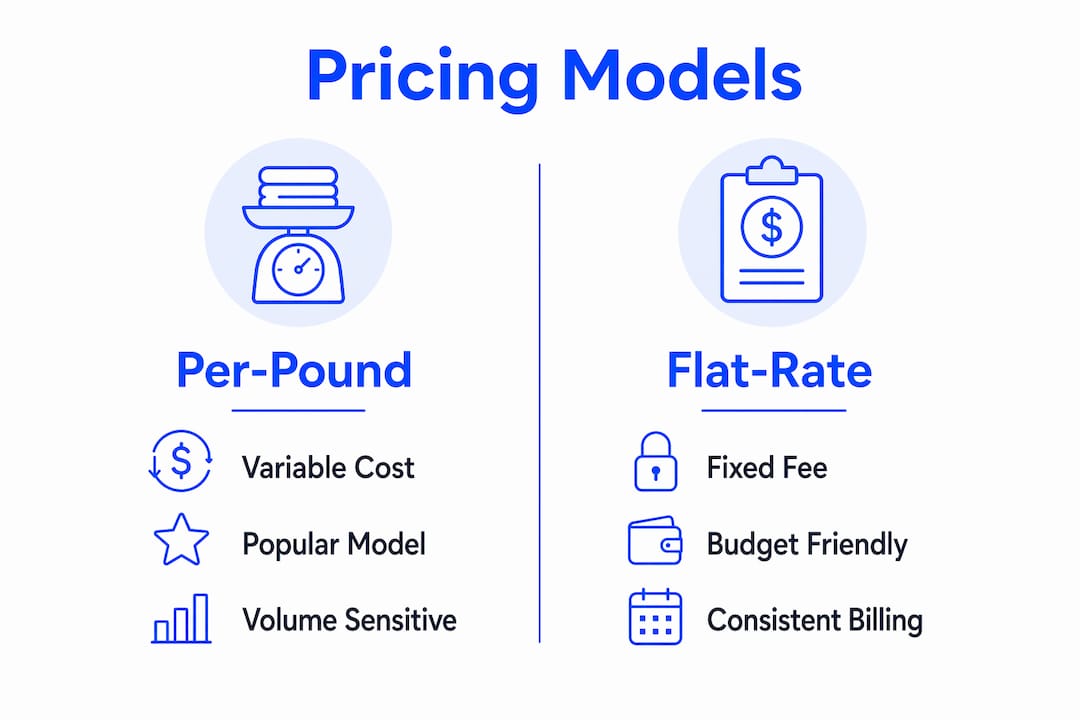
Per-pound pricing is the most widely used model for bulk laundry service rates. You pay a set rate for every pound processed, which gives you flexibility when your volume fluctuates week to week. This model works well for restaurants, gyms, and households with unpredictable laundry loads. The downside is that costs can spike during high-volume periods without warning.
Flat-rate monthly subscriptions lock in a fixed fee for a defined volume of laundry per month. This model offers budget predictability and suits businesses with consistent, steady output. The risk is paying for capacity you do not use. Businesses with fluctuating laundry volumes benefit from per-pound billing flexibility, while fixed monthly contracts are the better fit for steady-volume operations like hotels or uniform services.
Per-item pricing is reserved almost exclusively for specialty pieces. Per-item rates typically run $15 to $40 per piece for items like comforters, spa robes, or tailored garments. This model is rarely practical for high-volume bulk work, but it is the right choice when fabric care and individual attention matter more than throughput.
The table below summarizes how these models compare across the most relevant decision factors.
| Pricing Model | Typical Rate | Best For | Main Risk |
|---|---|---|---|
| Per-pound | $0.65–$3.50/lb | Variable-volume customers: gyms, Airbnb hosts, restaurants | Costs spike during peak periods |
| Flat-rate monthly | Fixed fee per volume tier | Hotels, uniform services, consistent weekly output | Paying for unused capacity |
| Per-item | $15–$40 per piece | Specialty items: comforters, robes, tailored garments | Expensive at scale; impractical for bulk |
For a deeper look at how per-pound billing tiers work in practice, the per-pound pricing guide from Columbiapikelaundry breaks down exactly how charges are calculated at different volume levels.
Which factors influence the total cost of bulk laundry services?
The per-pound rate on a service quote is only the starting point. Several variables can push your actual monthly bill well above what the headline number suggests.

Volume thresholds and tiered discounts are the single biggest lever available to high-volume buyers. Customers processing over 1,000 lbs weekly can negotiate 20 to 35% lower per-pound rates, with most providers offering price breaks at the 500 lb and 1,000 lb marks. That discount range represents a significant annual saving for any business running consistent volume.
Pickup and delivery logistics add cost that many buyers overlook when doing a laundry service cost analysis. Delivery surcharges typically run $5 to $15 per trip, and minimum load requirements between 25 and 200 lbs are common. If your volume does not meet the minimum, you pay for weight you did not generate.
Material type and soil level directly affect processing time and chemical use. Heavily soiled kitchen linens or grease-stained uniforms cost more to process than standard hotel towels. Providers often charge a soil surcharge of 10 to 20% for loads that require pre-treatment or extended wash cycles.
Turnaround time is a cost multiplier that catches many buyers off guard. Rush or same-day service adds a 15 to 50% premium to the base rate. Standard turnaround across most commercial providers runs 24 to 48 hours. If your operation regularly needs faster returns, build that premium into your cost model from the start.
Pro Tip: Request a fully itemized quote that includes delivery fees, fuel surcharges, minimum load penalties, and rush service rates before you compare providers. A low per-pound rate with high ancillary fees can easily cost more than a higher per-pound rate with no extras.
How does in-house laundry cost compare to outsourcing in 2026?
In-house laundry appears cheaper on the surface because the per-load cost of water and detergent is low. The real cost picture changes dramatically once you account for every expense category.
In-house laundry costs include water, energy, chemicals, labor, equipment depreciation, maintenance, and space allocation. The industry term for this full accounting is the “fully burdened cost per kilogram.” Most operations that calculate this number for the first time discover their actual cost is two to three times higher than they assumed. Underestimating fully burdened laundry costs leads to poor budget decisions that compound over time.
The table below provides a framework for calculating your in-house cost per kilogram.
| Cost Category | What to Measure | Typical Monthly Range |
|---|---|---|
| Water and sewer | Gallons per cycle × utility rate | Varies by location and volume |
| Energy (gas/electric) | kWh per dryer cycle + washer draw | Significant in urban markets |
| Chemicals and detergent | Cost per load × monthly load count | $0.09–$0.22 per load depending on format |
| Labor | Hours × fully loaded wage rate | Often the largest single cost category |
| Equipment depreciation | Purchase price ÷ useful life in months | Spread over 7–10 year equipment lifespan |
| Maintenance and repairs | Annual service contracts + unplanned repairs | Typically 3–5% of equipment value annually |
| Space allocation | Square footage × cost per sq ft | High impact in urban commercial real estate |
In-house laundry is cost-competitive only at very high, consistent volumes, such as hotels with 2,000 or more rooms where equipment utilization reaches 75 to 85%. Below that threshold, the fixed costs of equipment and space make outsourcing the more economical choice for most operations.
Outsourcing laundry services saves 23 to 38% on total laundry-related costs by eliminating labor, utilities, maintenance, and space expenses. Those savings are highest in urban markets where labor and real estate costs are elevated. For a small business or household in Arlington, Virginia, outsourcing to a local provider like Columbiapikelaundry is almost always the more cost-effective path once all expenses are on the table.
Pro Tip: Before deciding to keep laundry in-house, calculate your fully burdened cost per kilogram for three consecutive months. Include every expense category in the table above. Most operations find the number is high enough to justify outsourcing immediately.
How to accurately compare bulk laundry service rates to find the best value
Getting the best value from a bulk laundry price comparison requires looking beyond the per-pound rate. The following steps give you a structured framework for evaluating any provider.
-
Calculate total monthly cost, not just per-pound rate. Add the base rate, delivery fees, fuel surcharges, and any minimum load penalties. Even a low per-pound rate can be offset by delivery fees and minimums, making total monthly cost the only number that matters for a real comparison.
-
Verify exactly what is included in the service. Confirm whether folding, sorting, stain treatment, and specialty item handling are part of the base price or billed separately. A provider charging $1.50 per pound with folding included often beats one charging $1.20 per pound that bills folding as an add-on.
-
Review damage and loss policies in writing. Ask every provider how they handle lost items, fabric damage, and shrinkage. Providers without clear written policies on these contingencies represent a financial risk that does not show up in the per-pound rate.
-
Use volume projections to negotiate tiered pricing. If you can commit to a consistent weekly volume, use that commitment as leverage. Most commercial providers will offer structured discounts at defined thresholds. Bring three months of historical laundry data to any negotiation.
-
Check contract terms for flexibility. Month-to-month agreements cost slightly more per pound but protect you if your volume drops or your needs change. Annual contracts offer better rates but can lock you into minimums that become expensive during slow periods.
Pro Tip: Ask for a two-week trial run before signing any contract. This lets you verify turnaround times, folding quality, and communication responsiveness under real conditions. A provider confident in their service will agree without hesitation.
For a broader look at what drives laundry service pricing, Columbiapikelaundry’s pricing guide covers both residential and commercial scenarios in detail.
Key takeaways
The most accurate bulk laundry cost comparison requires calculating total monthly cost across all fee categories, not just the per-pound rate, because hidden charges routinely add 20 to 40% to the base price.
| Point | Details |
|---|---|
| Know your pricing model | Per-pound suits variable volumes; flat-rate works best for consistent, predictable weekly output. |
| Account for hidden fees | Delivery surcharges, fuel fees, and minimum load penalties can add 20–40% above the base per-pound rate. |
| Calculate fully burdened in-house costs | Include labor, equipment depreciation, space, and utilities before concluding in-house laundry is cheaper. |
| Leverage volume for discounts | Committing to 500 or 1,000 lbs weekly unlocks 20–35% lower per-pound rates with most providers. |
| Compare total monthly cost | Request fully itemized quotes and run a side-by-side monthly total before choosing any provider. |
What I’ve learned from watching businesses get laundry pricing wrong
The most consistent mistake I see is treating the per-pound rate as the whole story. A business owner will get three quotes, pick the lowest number, and sign a contract. Six weeks later, they are paying more than they budgeted because the delivery fees, minimum load penalties, and rush service charges were never factored in.
The second mistake is assuming in-house laundry is automatically cheaper because the detergent is cheap. Buying detergent in bulk reduces cost per load by up to 22%, which sounds meaningful until you realize that detergent is typically the smallest cost category. Labor and equipment depreciation dwarf it. I have seen small hotel operators run the numbers for the first time and discover their in-house cost per kilogram was nearly double what a local commercial service would charge.
The third mistake is underestimating the value of consistency and accountability. A provider who does the cleaning in-house, like Columbiapikelaundry, gives you a single point of contact for quality issues. Middle-man platforms that outsource to third-party facilities create accountability gaps that are nearly impossible to resolve when something goes wrong.
My honest advice: run a full cost audit before you commit to anything. Include every expense category, get itemized quotes from at least three providers, and negotiate based on volume. The businesses that get the best rates are the ones that show up with data.
— Daniel
How Columbiapikelaundry simplifies bulk laundry for Arlington businesses and residents
Columbiapikelaundry handles all cleaning in-house at our Arlington, Virginia storefront at 2602 Columbia Pike, which means you get consistent quality and direct accountability on every order. We offer pickup and delivery laundry service across the Arlington area, with standard 48-hour turnaround and express options available when you need faster results. Our pricing is transparent, with no hidden fuel surcharges or surprise minimum penalties. Whether you are a household looking to reclaim your weekends or a small business managing regular linen and uniform loads, we can build a service plan around your actual volume. Get a custom quote and see exactly what your monthly cost looks like before you commit to anything.
FAQ
What is the average cost per pound for bulk laundry service?
Commercial laundry services charge $0.65 to $3.50 per pound depending on location, volume, and service options. Urban markets typically run $1.75 to $3.50 per pound, while suburban providers are closer to $1.00 to $1.75 per pound.
How much can I save by outsourcing laundry instead of doing it in-house?
Outsourcing typically saves 23 to 38% on total laundry costs by eliminating labor, equipment, maintenance, and space expenses. Savings are highest in urban areas where utilities and wages are elevated.
What hidden fees should I watch for in bulk laundry service contracts?
Delivery surcharges of $5 to $15 per trip, fuel fees, and minimum load requirements between 25 and 200 lbs are the most common hidden costs. Always request a fully itemized quote before signing.
When does per-pound pricing make more sense than a flat monthly rate?
Per-pound pricing suits customers with variable or unpredictable laundry volumes, such as Airbnb hosts or seasonal businesses. Flat-rate contracts work better when your weekly output is consistent and predictable.
Can I negotiate lower rates for large volume laundry orders?
Most commercial providers offer structured discounts at 500 lb and 1,000 lb weekly thresholds, with savings of 20 to 35% off the standard per-pound rate. Bringing documented volume history to the negotiation significantly strengthens your position.
Free pickup, expert care, delivered back to your door.
Popular Blog Articles





Meet the Author
Daniel Logan didn’t start CPL because he loved laundry. He started it because his family was drowning in time debt, and laundry was one of the biggest weights.
Mornings were chaos with two kids under 5. Evenings felt like catch-up. And weekends? Gone to sorting socks and folding piles.
He knew his story wasn’t unique. So he built a business that gave families like his just a little bit of breathing room one load at a time.
With no laundry experience but deep tech skills, Daniel rolled up his sleeves, doing every job himself while building systems that turned it into a modern laundry service that saves customers time, simplifies their lives, and delivers reliability they can count on.
That’s where CPL began. Not from a playbook, but from pain. From one dad trying to buy back time: for himself, and for every household like his.
Free pickup, expert care, delivered back to your door.