
Laundry Service for Small Business: A Complete Guide

Columbia Pike Laundry offers pickup & delivery across Northern Virginia.
A lot of small business owners are still doing laundry the hard way. A salon owner throws towels into a back-room washer between appointments. A café manager takes aprons home at night. A clinic receptionist starts a load before closing because nobody else has time. It works, until it doesn’t.
The problem usually isn’t the washing itself. It’s the constant interruption. Laundry pulls staff away from customers, treatment rooms, prep work, and the hundred other tasks that move a business forward. It also creates a low-grade management burden that never really leaves. Someone has to notice the pile, sort it, run it, dry it, fold it, track what’s missing, and deal with the machine when it acts up.
That’s why the right laundry service for small business isn’t a luxury purchase. For many micro-businesses, it’s an operations decision. If you run a shop with a lean team, every recurring task needs to justify the time it consumes. Laundry often doesn’t.
Why Outsourcing Laundry Is a Strategic Business Move
The fastest way to think about business laundry is this. If an employee is washing towels, they’re not doing the job you hired them to do.
For a hair salon, that means less time turning over stations or serving clients. For a small café, it means slower prep and closing. For a wellness clinic, it means front-desk staff doing back-of-house work. None of that shows up cleanly on a profit-and-loss statement, but you feel it every day in delays, clutter, and mental fatigue.
The hidden costs are usually operational
Owners tend to compare only one thing. What it costs to pay a laundry provider versus what it costs to run a washer and dryer in-house. That’s too narrow.
In practice, in-house laundry usually brings four separate costs:
- Labor diversion: Staff spend time washing, drying, folding, and restocking instead of serving customers.
- Inconsistent output: Loads get rushed, mixed together, over-dried, or left sitting overnight.
- Equipment strain: Consumer machines aren’t built for repeated commercial use and wear out faster under business volume.
- Management drag: Somebody still has to own the process, answer questions, and fix mistakes.
Practical rule: If laundry has become “whoever has a minute” work, it’s already costing more than it looks.
There’s also a broader market signal worth paying attention to. The global online laundry service market is projected to grow at a 35.7% CAGR from 2024 to 2030, which reflects a shift toward treating laundry services as an operational tool rather than a convenience purchase, according to Grand View Research on the online laundry service market.
Small teams benefit the most
Large companies can hide inefficiency for a while. Small ones can’t. When you have a team of a few people, one recurring task can distort the whole day.
That’s why I usually tell owners to think about laundry the same way they think about bookkeeping, payroll, or even a marketing strategy decision for growth. You can keep everything in-house, but that doesn’t mean you should. The right question is whether the task belongs on your team’s plate at all.
What works is simple. Outsource repeatable, non-core work that demands consistency. Keep control over service standards, inventory expectations, and communication. Don’t keep the folding just because you’re used to it.
What doesn’t work is half-outsourcing. If you still have staff doing overflow loads on weekends, storing backup piles in random closets, and chasing missing items manually, you haven’t solved the problem. You’ve just made it messier.
Understanding Your Commercial Laundry Needs
Before you compare providers, get clear on what you send out. Most micro-businesses don’t need a giant institutional program. They need a provider that can handle their specific mix of items, schedule, and care requirements without overselling them.

The good news is the market already supports smaller operators. In the United States, the laundry facilities and dry-cleaning services market is valued at USD 12.9 billion, with residential and small business customers accounting for the majority of revenue, as noted by Research Nester’s dry-cleaning and laundry services market analysis.
Three common service buckets
Most businesses fit into one or more of these categories.
Linen and towel service
This is the most common need for salons, spas, fitness studios, estheticians, massage practices, short-term rentals, and some cafés.
You’re usually dealing with items that pile up fast, stain easily, and need a dependable reset. Towels, sheets, cleaning cloths, and service linens fall here. If your issue is volume and repetition, this is likely your main category.
Uniform and garment care
Restaurants, clinics, dental offices, home service companies, and boutiques often fall into this group.
Uniforms create a presentation standard. They also create accountability problems when washed casually at home by different employees. If your staff wear branded shirts, aprons, scrubs, or work garments, you need a provider that can separate, clean, and return those items consistently.
Specialty items
Many business owners find this challenging. Specialty items include comforters for rentals, treatment blankets, delicate pieces, mats, or garments that need dry cleaning rather than standard wash-and-fold.
These jobs don’t happen every day, but they matter because mistakes are expensive and inconvenient.
If a provider treats every item like a towel, they’re not set up for your business.
Know your communication needs too
Some owners focus only on cleaning and forget the service side. If you miss calls while serving customers, front-desk support matters. For teams that rely on quick response to scheduling questions, overflow call handling like Eden support for laundry companies can be relevant when you’re evaluating how professionally a provider handles client communication.
A practical starting point is to write down three things: what items you send out every week, what items need special care, and what timing problems keep happening now. Once you have that, you can evaluate a provider’s small business laundry offering based on your actual workflow instead of a generic sales pitch.
Decoding Laundry Service Pricing Models
Pricing looks confusing until you realize most providers use just a few basic structures. Once you know which model matches your business, price sheets get much easier to read.
Per-pound pricing
This is the standard model for wash-and-fold items. Think towels, rags, everyday linens, and other washable bulk goods.
It works a lot like buying produce by weight. You’re paying for volume, not for the uniqueness of each item. If your business generates a steady pile of similar laundry, per-pound pricing is usually the simplest and easiest model to manage.
This model tends to work well for salons, gyms, small rentals, and cafés with reusable cloth items.
Per-item pricing
This is common for garments that need individual handling. Suits, dresses, aprons with special finishing needs, scrubs with specific requirements, lab coats, and dry-clean-only pieces often fall into this category.
Per-item pricing makes sense when the item itself determines the care process. You’re not paying for total bag weight. You’re paying for attention, handling, and the correct cleaning method.
Businesses with mixed loads often need both systems at once. Towels might go under wash-and-fold pricing, while uniforms and presentation garments are billed separately.
Flat-rate or recurring service plans
Some providers offer recurring plans for businesses with predictable weekly volume. This can make budgeting easier if your laundry output doesn’t swing wildly.
The trade-off is flexibility. Flat structures are useful when your demand is stable. They’re less useful if your business has seasonal peaks, frequent schedule changes, or an uneven item mix.
A pricing model is only “cheap” if it matches the kind of laundry you actually produce.
A few practical questions help cut through the noise:
- What is included: Ask whether folding, bagging, sorting, and basic stain treatment are built into the quoted service.
- What is billed separately: Bulky pieces, dry cleaning, and special-care items often sit outside the main rate.
- What is the minimum: Many pickup routes require a minimum order to make logistics work.
If you’re comparing options locally, start with published Dry cleaning rates and then map them to your own item mix. Don’t compare a per-pound quote to a per-item quote without sorting your laundry into categories first. That’s where owners make bad assumptions and pick the wrong plan.
The best pricing setup is the one that gives you predictable service without forcing you to pay for handling you don’t need.
The Logistics of Pickup Delivery and Turnaround Time
Most owners don’t worry about laundry itself. They worry about losing control once the bags leave the building.
That concern is fair. If pickup is sloppy or delivery windows are vague, the service creates a new problem instead of solving the old one.
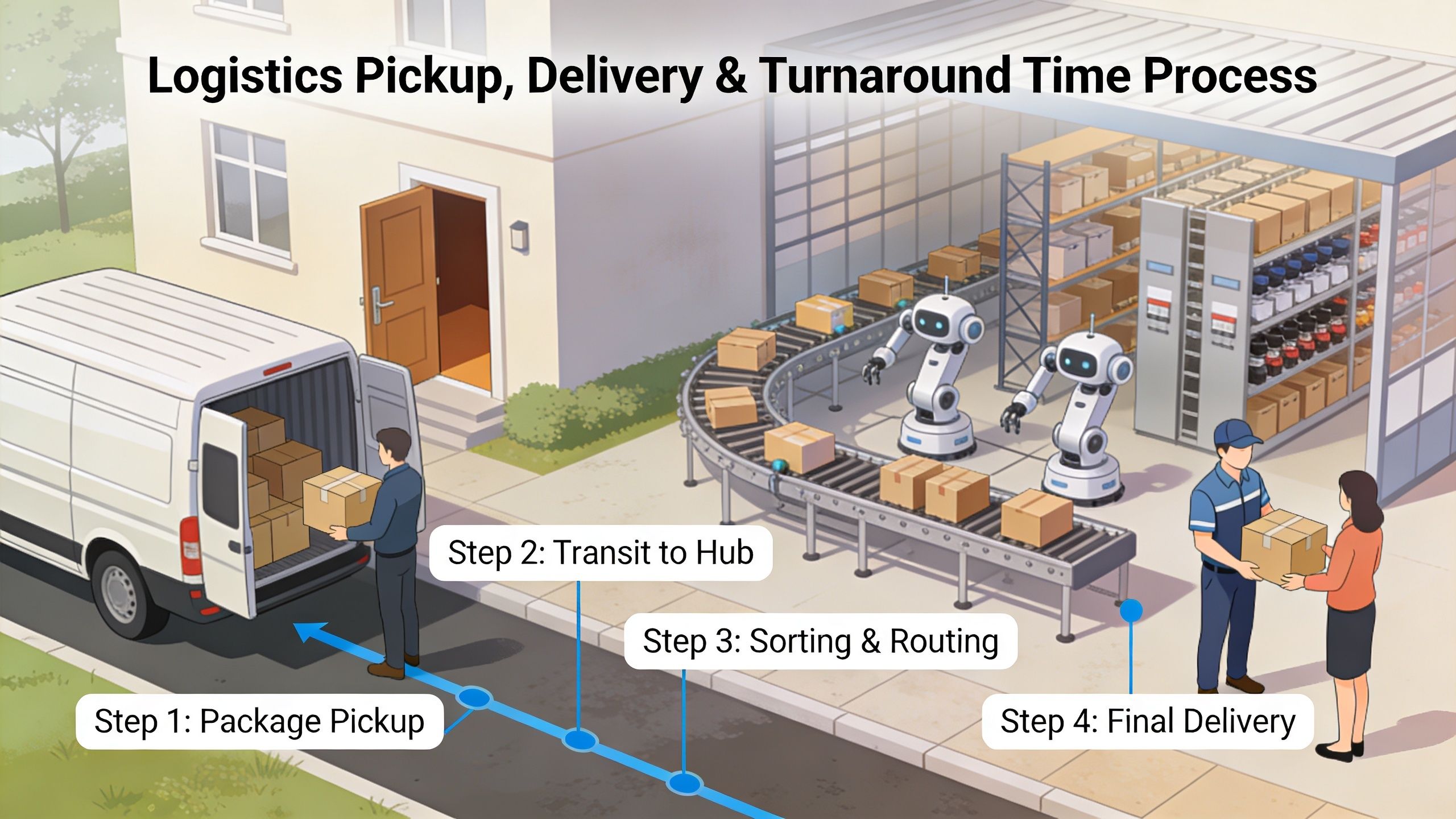
What a good cycle looks like
A typical business cycle should feel boring in the best possible way.
You schedule service online or through an app. Your team bags the items and separates standard laundry from dry cleaning if needed. Pickup happens from a front desk, side entrance, package room, or another prearranged spot. You get updates, the order is processed, and clean items return folded, hung, or packaged according to the job.
That’s the standard most small businesses should expect from a modern pickup and delivery setup.
Why routing technology matters
This is one place where software changes the customer experience. Modern laundry management software can cut delivery costs by 20% to 30% and improve on-time rates to over 95% through route optimization, according to Sharetribe’s analysis of laundry marketplace operations.
For a business owner, that matters because reliability is the product. You don’t care whether a driver took the ideal route in theory. You care that clean towels arrive before the first appointment and uniforms are back before the next shift.
Turnaround is about workflow, not speed alone
Fast isn’t always the main issue. Predictable is.
For example, if your business knows exactly when items leave and exactly when they return, you can stock less backup inventory and stop scrambling. A dependable routine often matters more than shaving a few hours off the cycle.
For Columbia Pike Laundry specifically, the published turnaround is 48 hours for laundry and 3 days excluding Sunday for dry cleaning, with express laundry available within 24 hours, based on the company’s stated service information. If you need confirmation for a specific garment or an unusual dry-cleaning timeline, a team member should confirm it directly rather than guessing.
The test of a laundry provider isn’t whether they promise convenience. It’s whether your staff can stop thinking about laundry after pickup.
What doesn’t work is vague scheduling, unclear bag instructions, or no status communication. Small businesses need a provider that fits into existing routines, especially when the front desk is busy and nobody has time to chase updates.
How to Choose the Right Laundry Service Partner
Choosing a laundry provider is closer to hiring an operations partner than buying a commodity. Price matters, but it’s rarely the thing that causes regret. Regret usually comes from missed details, poor communication, and preventable mistakes.
Start with the equipment question
Ask what kind of machines the provider uses. This isn’t a technical nicety. It tells you a lot about quality control, sanitation standards, and whether the business is built for commercial volume.
High-efficiency commercial washers reduce water usage by up to 50% and energy consumption by 30% to 40% compared to residential machines, according to this commercial laundry equipment guide. For you, that translates into a provider that’s more likely to process laundry consistently, handle heavier loads properly, and avoid the corner-cutting that happens when a business relies on residential-style setups.
Evaluate like an operator
I’d look at a provider through five lenses.
Sanitation and handling
If you run a clinic, salon, wellness space, or food business, ask how items are sorted and processed. You want clear handling practices, not vague reassurance.
Look for answers to questions like these:
- Separation standards: Are whites, colors, delicates, and specialty items handled separately?
- Detergent options: Can they accommodate fragrance-free or specific product requests?
- Special instructions: Do they capture notes for stains, air-dry requests, or hanging preferences?
Flexibility of service
Small businesses change quickly. Your laundry plan should be able to change too.
A good provider can usually adapt when you add a second location, change business hours, increase towel usage, or need a recurring schedule. A rigid provider creates friction every time your business evolves.
Invoicing and admin
Many services feel amateur here.
You want clean billing, readable receipts, and a process your bookkeeper won’t hate. If you need itemized invoices, recurring billing, or custom notes by department or location, ask upfront. Don’t assume.
Problem resolution
Ask directly what happens if an item is damaged, delayed, or missing. The answer matters as much as the policy itself.
Good providers don’t dodge this question. They explain the reporting process, who handles the issue, and how re-cleaning or credits work if something goes wrong.
Watch for signs of operational maturity
These details usually separate a dependable partner from a side business:
- Consistent communication: Text or email updates reduce guessing.
- Documented preferences: Your instructions shouldn’t have to be re-explained every order.
- Business-friendly scheduling: Pickup windows need to align with your hours, not the other way around.
One local option in this category is Columbia Pike Laundry, which offers wash-and-fold, dry cleaning, and pickup and delivery for individuals and small businesses, along with custom preferences and invoicing options for commercial clients based on the company’s published service information.
The cheapest provider can still be the most expensive if they create staff frustration, rework, or inventory problems. A strong partner makes laundry less visible inside your business. That’s the standard.
Calculating Your Potential Cost Savings
Most owners don’t need a complicated spreadsheet. They need a quick way to decide whether outsourcing saves money or moves money around.
Start with labor. For a small business, a conservative estimate of 5 staff hours saved per week at a $20 per hour wage equals $5,200 in reclaimed labor costs per year, according to Sparklean’s guide to laundry service for small businesses.
That number matters because labor is usually the hidden cost owners undercount. They remember detergent and utility bills. They forget the hours.
A simple decision formula
Use this rough framework:
In-house cost = staff time + supplies + utilities + machine wear + management hassle
Outsourced cost = weekly service total + any specialty item charges
If the outsourced total is lower, or even close while removing a recurring headache, it deserves serious consideration.
Sample Weekly Cost-Benefit Analysis
| Cost Factor | In-House (Your Calculation) | Outsourced (Example) |
|---|---|---|
| Staff time spent on laundry | 5 hours x your hourly wage | Minimal staff handling |
| Detergent and cleaning supplies | Add your weekly estimate | Included or billed through service |
| Water and electricity | Add your weekly estimate | Not your direct operating burden |
| Machine wear and maintenance | Add your weekly estimate | Not your direct operating burden |
| Rewashing, sorting errors, interruptions | Add your weekly estimate | Reduced when process is standardized |
| Weekly service fee | N/A | Quote from provider |
| Specialty items | N/A | Add if applicable |
| Total weekly cost | Your total | Service total |
Quick test: If laundry keeps interrupting revenue-generating work, don’t evaluate it as a utility expense. Evaluate it as a labor and workflow expense.
For a boutique salon, café, or clinic, this is usually enough to make the decision clearer. If you want a cleaner comparison, track one ordinary week. Count who touched the laundry, how long it took, and what else got delayed. That’s your baseline.
Your Local Laundry Solution in Arlington and DC
If you’re in Arlington or DC and you’re tired of having towels, uniforms, or shop linens take over your week, there’s no reason to keep forcing an in-house system that’s already wearing your team down.

A local service should do three things well. Make scheduling easy, clean items properly, and return them when promised. That sounds basic, but it’s exactly what small businesses need.
If you’re evaluating a local option, keep the start simple:
- Review pricing and service types so you know whether your mix is mostly wash-and-fold, dry cleaning, or both.
- Schedule the first pickup online and give clear instructions about where items should be collected and returned.
- Bag and label what matters especially if you’re mixing everyday laundry with garments that need special care.
For businesses that want fewer moving parts, local pickup and delivery can be a practical way to keep operations tidy without assigning laundry duty to your staff. The right provider should feel like one less thing to manage, not one more vendor to babysit.
Frequently Asked Questions for Businesses
What if something is damaged or doesn’t come back right
Ask about this before you start service. A professional provider should explain how to report the issue, what documentation they need, and whether they re-clean, credit, or review the order internally. If the answer is vague, keep looking.
Can I mix wash-and-fold and dry cleaning in one order
Yes, many businesses do. The important part is separating the items clearly and labeling them if needed. That avoids billing confusion and keeps care methods from getting mixed up.
Do I need a contract
Not always. Some providers work order by order, while others offer recurring schedules for businesses that want routine service. If your volume changes often, flexibility matters more than a formal plan.
What if I have sensitive fabrics or fragrance concerns
Bring it up early. Many providers can work with fragrance-free preferences, hanging requests, delicate handling, and special notes. The key is whether they’ve built a process for capturing those instructions consistently.
Can a laundry service handle small-volume businesses too
Yes. Small clinics, salons, cafés, and home-based businesses often benefit the most because they don’t have spare staff time to absorb laundry tasks. The decision usually comes down to whether the service reduces enough operational friction to justify the weekly cost.
If laundry is stealing staff time, crowding your back room, or creating one more thing to manage, Columbia Pike Laundry is a practical next step for Arlington and DC businesses. You can review services, check pricing, and schedule pickup online without a complicated setup. For small businesses, that often means fewer interruptions, cleaner presentation, and more time spent on the work customers pay you for.
Free pickup, expert care, delivered back to your door.
Popular Blog Articles



Meet the Author
Daniel Logan didn’t start CPL because he loved laundry. He started it because his family was drowning in time debt, and laundry was one of the biggest weights.
Mornings were chaos with two kids under 5. Evenings felt like catch-up. And weekends? Gone to sorting socks and folding piles.
He knew his story wasn’t unique. So he built a business that gave families like his just a little bit of breathing room one load at a time.
With no laundry experience but deep tech skills, Daniel rolled up his sleeves, doing every job himself while building systems that turned it into a modern laundry service that saves customers time, simplifies their lives, and delivers reliability they can count on.
That’s where CPL began. Not from a playbook, but from pain. From one dad trying to buy back time: for himself, and for every household like his.
Free pickup, expert care, delivered back to your door.