
Your Wash and Fold Franchise Guide for 2026
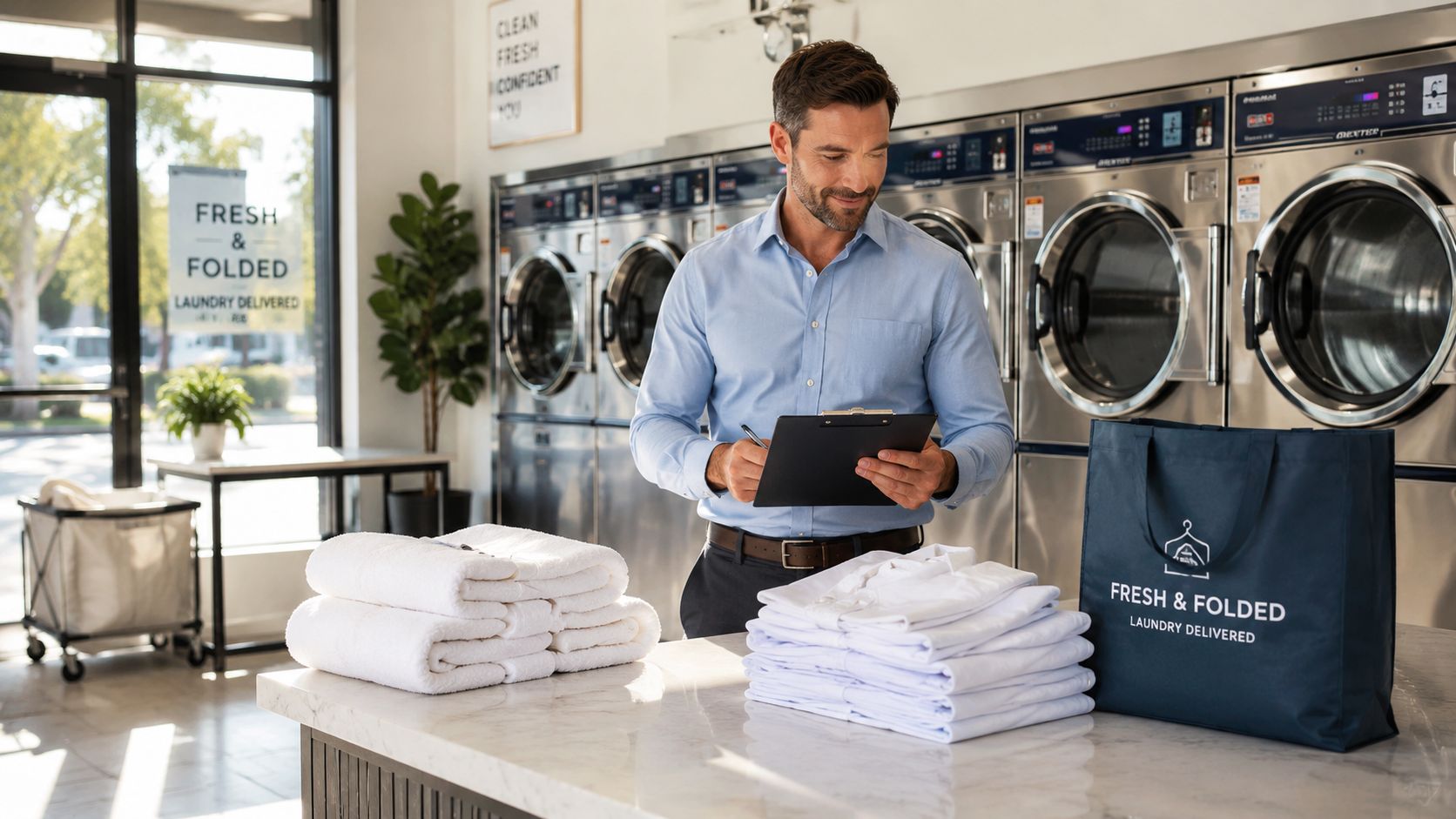
Columbia Pike Laundry offers pickup & delivery across Northern Virginia.
You're probably here because laundry feels more real than another screen-based business. You can see the customer, the workflow, the pickup bags, the folding tables, the neighborhood you serve. That's part of the appeal. A laundry business is tangible, local, and needed every week.
That instinct isn't small thinking. It points toward a service category with serious scale. The right way to evaluate a wash and fold franchise isn't to ask whether people need clean clothes. They do. The better question is whether you're buying a business built around wash and fold itself, or stepping into a laundromat where wash and fold is only one part of the machine.
Is a Wash and Fold Franchise Your Next Move
A lot of buyers start in the same place. They want a business that isn't abstract, doesn't depend on chasing trends, and serves people in a way they can understand on day one. Laundry checks those boxes. Families need it. Professionals need it. Small businesses need it. The demand is tied to ordinary life, not hype.
That demand sits inside a large category. The global dry-cleaning and laundry services market was estimated at USD 83.35 billion in 2025 and is forecast to reach USD 118.71 billion by 2030, according to Grand View Research's dry-cleaning and laundry services market report. That matters because a wash and fold franchise isn't some side hustle tucked inside a strip center. It belongs to a service market driven by convenience and repeat household need.
For a newcomer, the first mistake is thinking all laundry concepts are basically the same. They aren't. A self-service laundromat, a pickup and delivery business, a commercial linen route, and a store built around wash and fold each run differently. The labor model changes. The space needs change. The customer expectations change.
A good laundry business doesn't just clean clothes. It removes friction from someone's week.
That's why this category attracts both owner-operators and investors. It offers recurring demand, but it still punishes sloppy execution. If you're considering a franchise, the fundamental work starts after the marketing brochure. You need to understand what the business sells, what drives margin, and where owners get surprised.
Breaking Down Your Initial and Ongoing Costs
Laundry buyers often focus on equipment first. That's understandable, but incomplete. Your cost structure falls into two buckets: initial investment and ongoing operating expense. If you blur those together, your projections get messy fast.
Reported initial costs for laundry-style franchises range from $200,000 to over $1 million, often with $100,000 to $300,000 in liquid cash required and franchise fees between $20,000 and $50,000, based on this franchise cost review from Assett Franchise. That range is wide for a reason. A small attended operation and a fully built branded store with delivery infrastructure are not the same business.
Estimated Franchise Cost Breakdown
| Cost Category | Typical Range / Type | Notes |
|---|---|---|
| Franchise fee | $20,000 to $50,000 | Paid to the franchisor for brand access and system rights |
| Total initial investment | $200,000 to $1 million+ | Depends on build-out, equipment package, and model |
| Liquid cash requirement | $100,000 to $300,000 | Often required before financing is considered |
| Equipment | Major startup component | Washers, dryers, water heating, folding stations, carts |
| Build-out | Major startup component | Plumbing, electrical, ventilation, counters, intake area |
| POS and software | Startup plus recurring | Order tracking matters more in wash and fold than many buyers expect |
| Rent and utilities | Ongoing | Laundry uses a lot of power, water, and gas |
| Labor | Ongoing | For wash and fold, this becomes one of the biggest operating realities |
| Marketing and local promotion | Ongoing | Needed to fill routes and establish repeat habits |
| Royalty or system fees | Ongoing in many franchise systems | Review the franchise agreement carefully |
What gets missed in early planning
Buyers usually underestimate three things.
- Workflow build-out: Wash and fold needs more than machines. You need intake room, sorting space, folding surfaces, storage, and a clean handoff process.
- Working capital: Opening the doors isn't the same as reaching stable weekly volume. You need room to absorb a slow ramp.
- Price discipline: If your pricing doesn't match your labor reality, volume can make life harder.
A useful reality check is to compare your projected customer pricing against real market-facing laundry rates like Columbia Pike Laundry prices. Not because every market should charge the same, but because pricing has to support labor, overhead, and service quality.
Practical rule: Don't build your plan around “busy.” Build it around profitable throughput.
Ongoing expenses decide whether the model works
The first check gets the store open. The monthly expenses decide whether the business holds together. Rent, utilities, payroll, detergent, bags, customer support, software, and local marketing all keep hitting the account whether the route is full or not.
That's why a polished franchise deck can mislead inexperienced buyers. A beautiful store can still struggle if the route is too thin, labor is poorly scheduled, or order flow swings all over the week.
Questions to Ask Before You Sign
Most franchise shoppers ask the wrong first question. They ask, “Is this a good brand?” A better question is, “What business am I buying?”
Many franchise listings bundle wash-and-fold with self-service and commercial accounts, but the operational needs are very different. Buyers need to determine whether wash and fold is the core product or just a margin lever inside another model, because profitability depends heavily on labor and workflow space, not just machine count, as discussed by LaundryCard's look at wash-dry-fold in a laundromat model.
The distinction that changes everything
If wash and fold is the center of the model, then your business depends on intake accuracy, sorting standards, labor supervision, customer communication, and repeat order behavior.
If wash and fold is an add-on inside a traditional laundromat, the economics may lean more on self-service machine turns, ancillary sales, and occupancy efficiency. Those are not small differences. They affect hiring, floor plan, hours, marketing, and your own day-to-day role.
Questions that uncover the real model
Take these into every franchise conversation:
- What does the best-performing location sell? Ask whether top units rely mainly on self-service, pickup and delivery, commercial work, or store drop-off wash and fold.
- How much floor space is dedicated to wash and fold operations? If the answer is vague, that's a warning sign.
- What happens on a heavy-volume day? A real operator can explain intake bottlenecks, folding labor, storage pressure, and missed handoff risks.
- Can the concept run well if machine usage is strong but wash and fold is weak? The answer tells you what the true engine is.
- What role does the owner play when staffing gets tight? This reveals how “semi-absentee” the model really is.
If a franchisor talks mostly about equipment and site selection, but barely addresses order handling and labor control, they may be selling a laundromat with wash and fold attached, not a true wash-and-fold-centric business.
Review the documents like an operator
Marketing materials rarely answer the hard questions. The Franchise Disclosure Document is where you start checking what's promised against what's contractually required. If you want a structured way to compare systems, FDD analysis for franchisors can help you review franchise disclosures with a more critical eye.
Look closely at training, technology requirements, territory language, approved vendors, ongoing fees, and operational standards. Then ask yourself one blunt question: would this system still make sense if the brand name disappeared and all you had left was the actual workflow?
That test saves people from buying the wrong kind of laundry business.
Choosing Your Location and Defining Your Service Area
A wash and fold business doesn't live or die by traffic counts alone. It lives or dies by whether the right people are close enough, busy enough, and willing to build your service into their routine. For this model, “location” means two things at once: the storefront and the service zone around it.
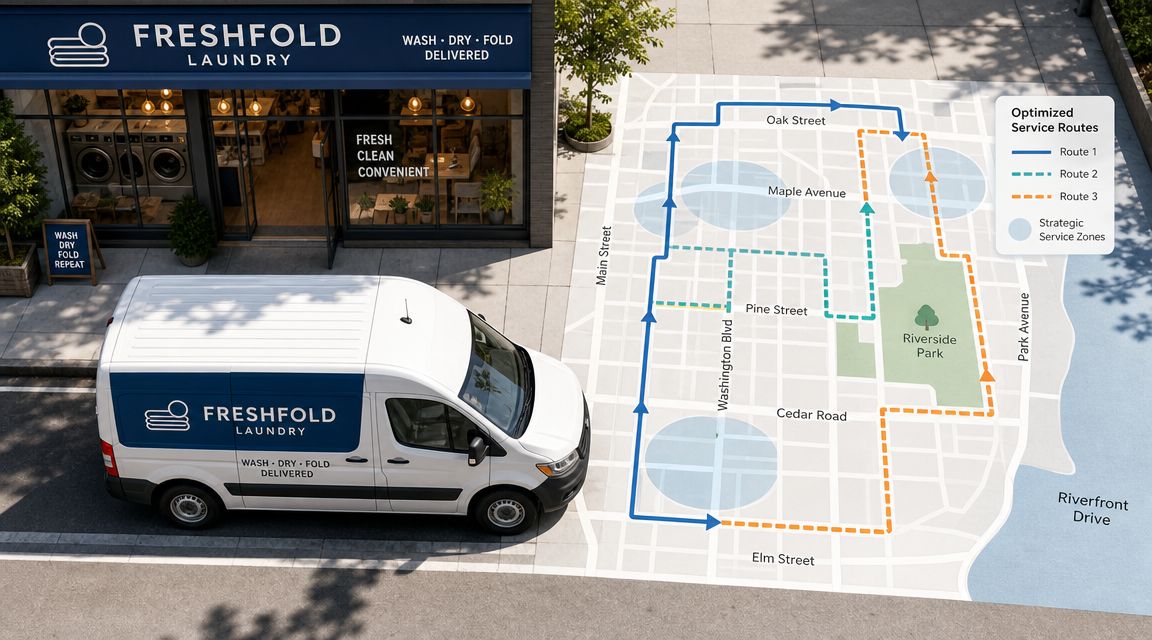
The strongest operators usually don't try to cover an entire metro area at the start. They build depth in a tighter area first. That gives the staff a manageable footprint, tighter delivery windows, and fewer wasted miles between orders.
What a good wash and fold location looks like
You're not just looking for residents. You're looking for time pressure.
- Busy households: Dual-income families, parents with young children, and professionals with long commutes often value consistency more than bargain pricing.
- Dense housing: Apartment corridors, townhome clusters, and compact neighborhoods are easier to serve repeatedly.
- Commercial adjacency: Gyms, spas, salons, and small hospitality operators can add steady order volume if your model supports it.
- Easy logistics: Parking, pickup access, and straightforward delivery routes matter more than many first-time buyers expect.
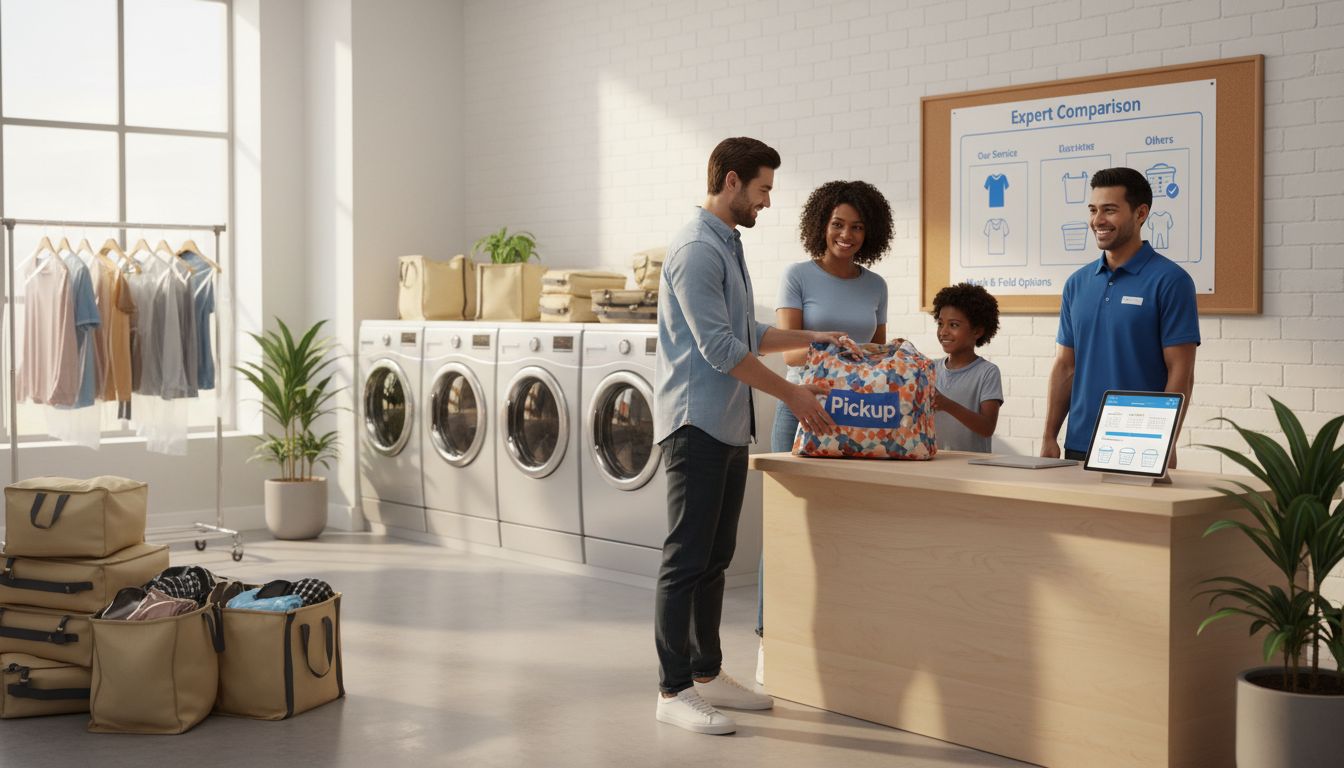
A practical service design example is laundry pickup and delivery. That kind of model works best when the operating area is defined carefully enough that pickups and drop-offs feel routine, not improvised.
Go deep before you go wide
Expansion is tempting because it feels like growth. In reality, wide service areas often hide weak density. The van stays moving, but the business doesn't get easier.
Here's a better sequence:
- Start with a tight zone: Make service windows dependable and route planning simple.
- Study order patterns: Learn which neighborhoods reorder, which buildings create friction, and which customer types are easiest to retain.
- Add adjacent pockets carefully: Expand only after the original zone runs smoothly.
Tight geography improves service quality. It also gives you cleaner labor scheduling and fewer delivery headaches.
Evaluate the street, then the map
A strong site still matters. People need to find it, park near it, and feel comfortable dropping off laundry. But with wash and fold, the map around the store often matters just as much as the storefront itself.
That's why some average-looking locations outperform prettier ones. The winner often sits in the middle of a dense, habit-driven customer base and can serve that base without wasting time on long route hops.
Mastering Your Staffing and Operational Workflow
Machines wash clothes. People protect the business.
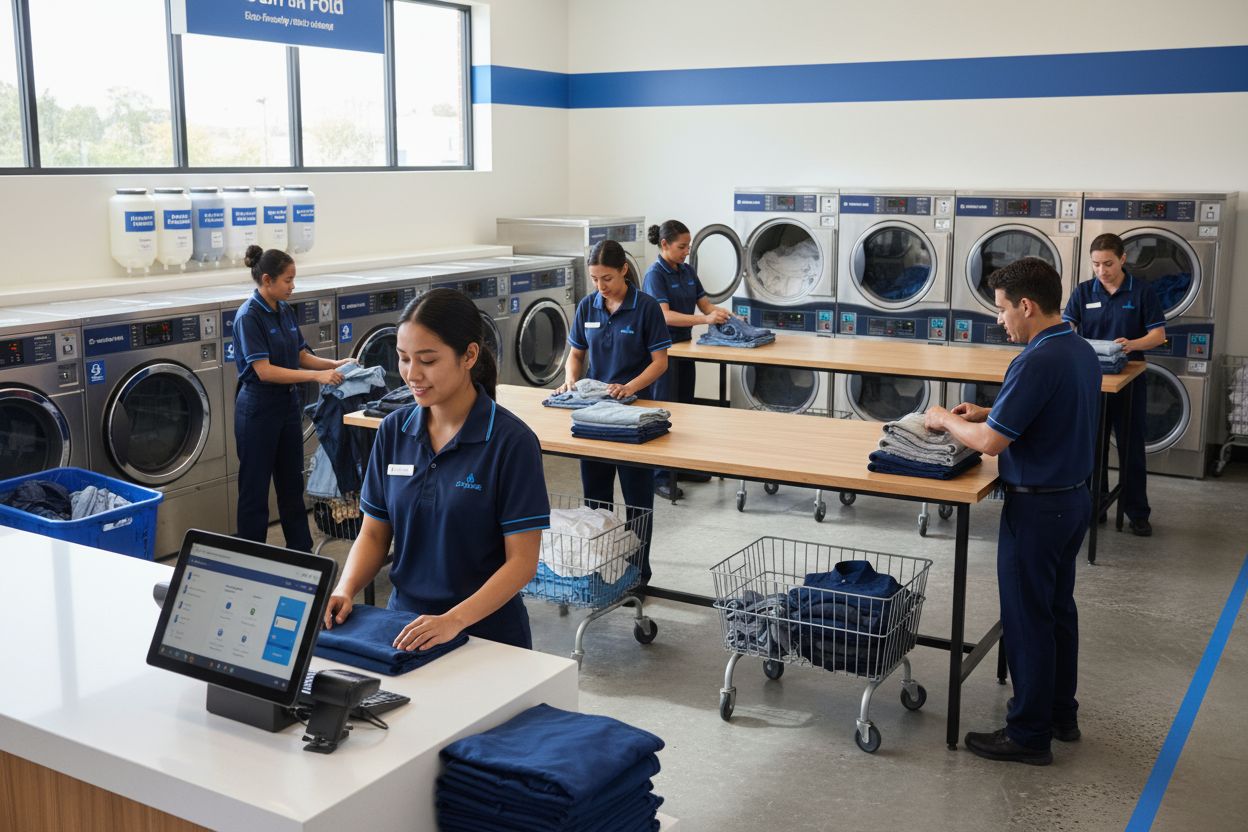
That's the simplest way to understand wash and fold operations. The work is labor-intensive by design. Modern equipment helps throughput, but it doesn't remove the human bottleneck in sorting, stain handling, folding, and quality control, as noted by WaveMAX's franchise overview. For owners, the key question isn't only whether the store can make money. It's whether it can stay profitable and run smoothly when the owner isn't physically present every day.
Build the workflow before you chase volume
A lot of early operators make the same mistake. They market aggressively before the physical process is stable. Then volume lands on a shaky system.
A cleaner sequence looks like this:
Intake
Every order needs a clear customer record, service type, and special instructions.Sort
This step protects garments and prevents rework. It also catches pocket items, stains, and problem loads.Wash and dry
Machine capacity matters, but scheduling matters just as much. Loads need to move without piling up at the next stage.Fold and bag
During this stage, quality becomes visible to the customer. Sloppy folding sends a message.Handoff
Orders need to leave the store complete, labeled correctly, and easy to verify.
Staffing mistakes that hurt margins
The biggest labor problems usually come from poor structure, not bad intentions.
- Undertraining new hires: If people learn by guessing, error rates rise.
- No cross-training: One strong folder or one intake lead cannot be your entire system.
- Weak quality checks: Missing items, mixed orders, and inconsistent folding damage trust fast.
- Owner dependency: If staff can't run a normal day without constant rescue, the model isn't ready to scale.
One useful outside read on process design is strategies to boost productivity. The principles apply well to laundry operations because they focus on tightening repeat workflows rather than adding chaos.
Good operators don't just hire for speed. They hire for consistency, care, and the ability to follow a repeatable process.
What to standardize first
You don't need a giant operations manual on day one. You do need absolute essentials.
Create written standards for:
- Order intake steps
- Pocket checks and stain identification
- How items are folded and packed
- What gets escalated to management
- How staff document customer preferences
That kind of standardization is what allows a wash and fold franchise to feel dependable instead of fragile. When customers trust that their clothes will come back right every time, they stop “trying” the service and start relying on it.
Marketing Strategies for Recurring Revenue
The best marketing in laundry doesn't sell clean socks. It sells time back, less household friction, and one less unfinished task hanging over the week. That message works best when it's aimed at the right people in the right area, then reinforced by a service experience worth repeating.
This isn't a broad-reach business first. It's a repeat-order business first. Industry sources report about 90% repeat customers for successful laundromats, and 87% of customers live within one mile of the facility, according to Press Cleaners' laundromat statistics roundup. That tells you something important. Sustainable growth comes from local density, not from trying to blanket a whole city with occasional orders.
Build habits, not one-time promos
Discounts can get a first order. They rarely build a business by themselves.
What works better:
- Weekly routines: Position the service as the customer's standing laundry plan, not an emergency backup.
- Simple recurring options: Weekly or bi-weekly cadence is easier to retain than random reactivation campaigns.
- Apartment and neighborhood focus: One building with strong adoption can matter more than scattered customers across town.
- Business accounts that fit your workflow: Small recurring accounts can stabilize production if they don't crowd out your core household business.
Message convenience in practical terms
A strong laundry offer doesn't need clever language. It needs clarity. Tell people what problem you remove.
Try messaging around:
- fewer errands
- less folding at night
- easier family routines
- dependable pickup and return
- cleaner closet management for busy households
Customers stay when your service becomes part of their week, not when your ad copy is memorable.
Local marketing that fits the model
For a wash and fold franchise, local outreach should match the service radius. Broad campaigns often waste money. Tighter targeting usually performs better because the offer is, by its nature, neighborhood-based.
Use a mix of:
- building managers and concierge relationships
- local search visibility
- direct outreach to small businesses that generate repeat laundry
- follow-up messaging that nudges second and third orders
- referral requests after a smooth completed order
The point isn't to create buzz. The point is to create routine. Once a customer trusts your process, your marketing job changes. It becomes retention, reminder, and service consistency.
Frequently Asked Questions
Can a wash and fold franchise be semi-absentee
Sometimes, but only if the system is designed for it and the staff is strong. Laundry is operationally repetitive, which helps. But wash and fold has a lot of handoffs, customer preferences, and quality control points. If the model depends on the owner fixing mistakes every afternoon, it isn't truly semi-absentee.
Is technology a major advantage in this business
Yes, especially for order tracking, route management, customer communication, and preference storage. Good software reduces confusion. It doesn't replace training. The stores that use technology well usually pair it with clear operating procedures.
How should I think about ROI and break-even
Start with unit economics, not hope. Look at the full investment, expected labor load, rent, utilities, and the time it may take to build dependable repeat business. If a seller talks about upside but avoids discussing staffing or workflow, slow down.
Should I market like a laundromat or like a home service business
More like a home service business if wash and fold is central to the model. You're competing on convenience, trust, and reliability. Some ideas from marketing strategies for home service contractors can translate well because they focus on local trust and repeat need.
What's the biggest mistake first-time buyers make
They assume all laundry franchises work the same way. The biggest win in due diligence is identifying whether wash and fold is the actual engine of the business or just one revenue stream inside a different model.
If you want to see how a real local operator presents wash and fold, pickup and delivery, and garment care in practice, take a look at Columbia Pike Laundry. It's a useful example of how a neighborhood laundry business can structure service around convenience, recurring customer needs, and clear operating options.
Free pickup, expert care, delivered back to your door.
Popular Blog Articles

Meet the Author
Daniel Logan didn’t start CPL because he loved laundry. He started it because his family was drowning in time debt, and laundry was one of the biggest weights.
Mornings were chaos with two kids under 5. Evenings felt like catch-up. And weekends? Gone to sorting socks and folding piles.
He knew his story wasn’t unique. So he built a business that gave families like his just a little bit of breathing room one load at a time.
With no laundry experience but deep tech skills, Daniel rolled up his sleeves, doing every job himself while building systems that turned it into a modern laundry service that saves customers time, simplifies their lives, and delivers reliability they can count on.
That’s where CPL began. Not from a playbook, but from pain. From one dad trying to buy back time: for himself, and for every household like his.
Free pickup, expert care, delivered back to your door.