
Business Laundry Management: A Practical Guide for Managers
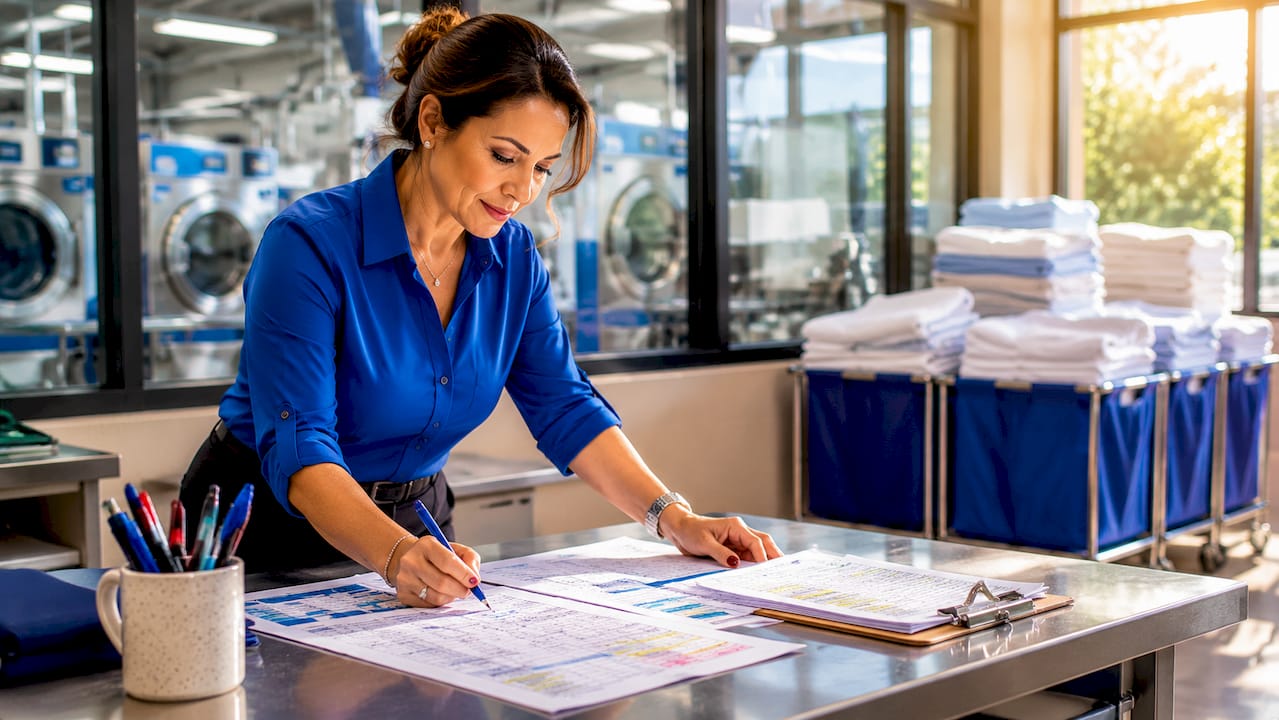
Columbia Pike Laundry offers pickup & delivery across Northern Virginia.
TL;DR:
- Effective business laundry management integrates workflows, staff, and technology to ensure cost-efficient, hygienic linen handling. Automation and centralized systems improve order tracking, communication, and staff coordination while reducing costs and contamination risks. Regular system reviews and proper hygiene protocols are essential for maintaining profitable, reliable operations.
Business laundry management is the strategic coordination of laundry workflows, staff, equipment, and customer communication to deliver clean, timely, and cost-effective linen handling for commercial clients. Whether you run a hotel, medical facility, restaurant, or outsourced laundry service, the gap between a profitable operation and a chaotic one usually comes down to how well you manage these moving parts. Systems like Picky Assist and platforms built around laundry CRM workflows have made it possible to centralize everything from order tracking to payment automation. Labor costs alone account for 40 to 60% of total commercial laundry expenses, which means operational discipline is not optional. It is the foundation of every dollar you protect.
What are the core components of business laundry management?
Effective business laundry management starts with a centralized system that connects every stage of the operation. A laundry management system handles order tracking, customer history, payment automation, and shared communication inboxes, replacing the spreadsheets and phone calls that slow most operations down. Without this infrastructure, errors compound across shifts and customer complaints become routine.
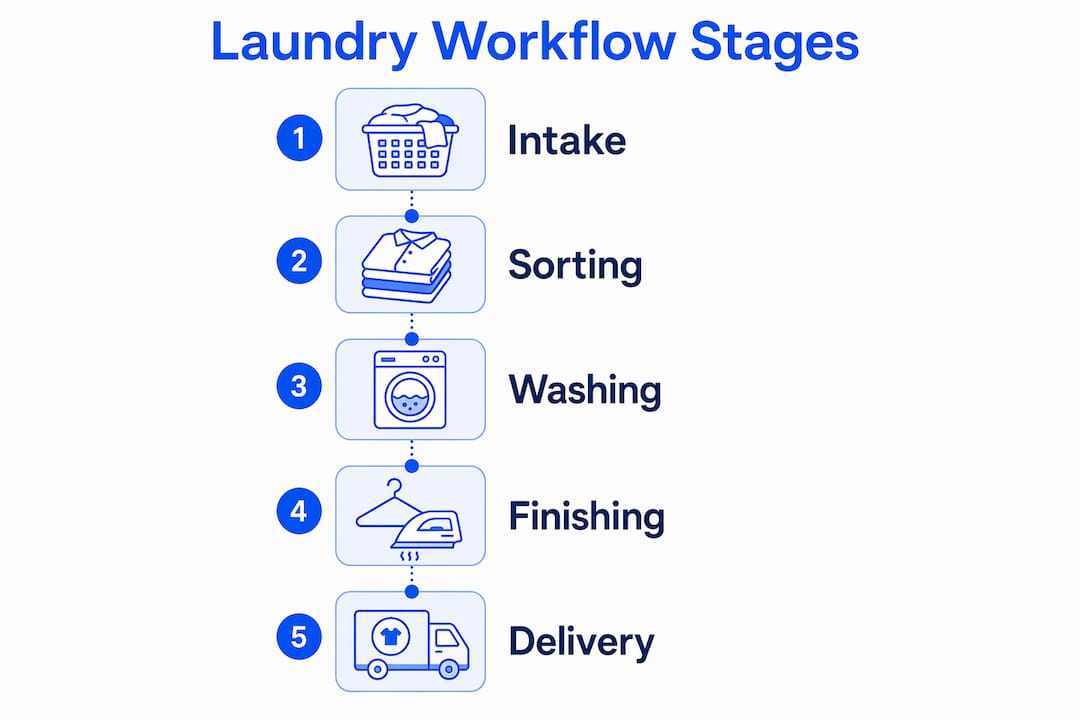
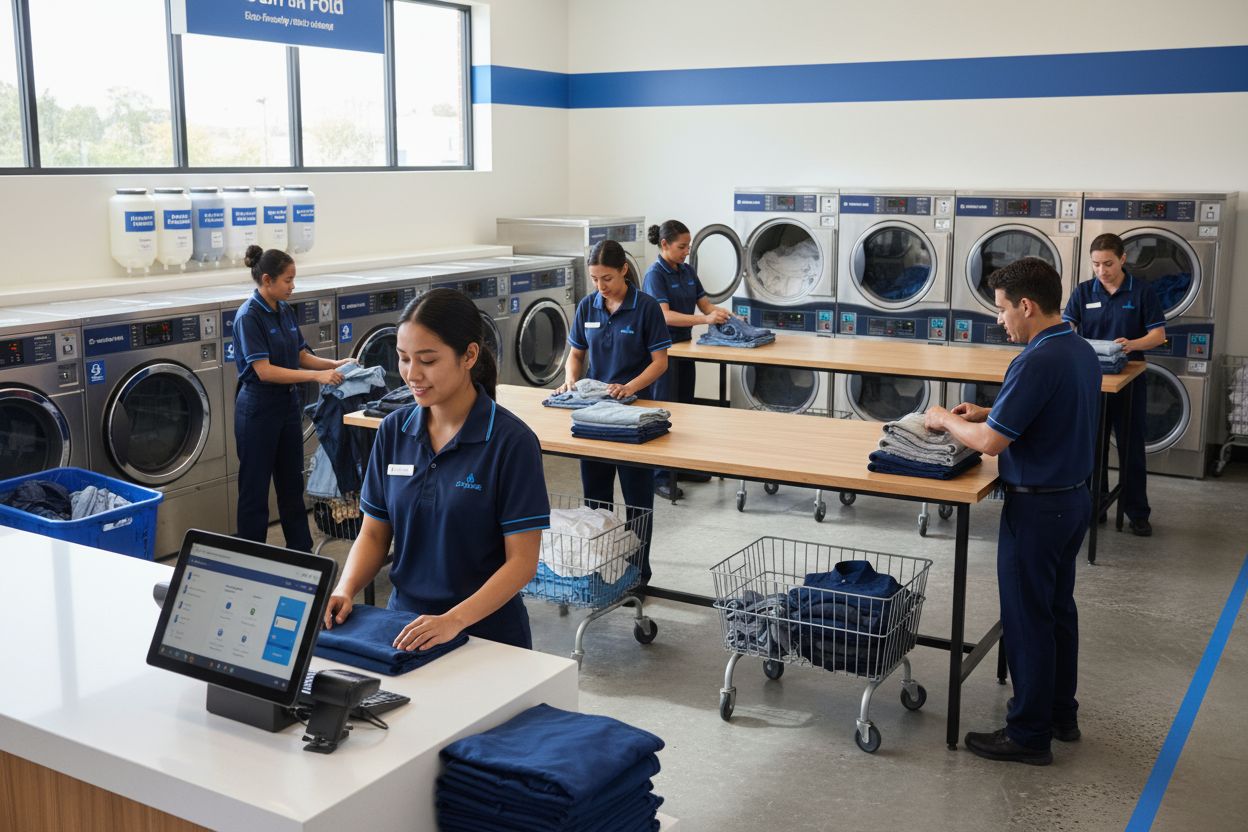
The core workflow moves through five stages: intake, sorting, washing, finishing, and delivery or pickup. Each stage needs a defined handoff point so nothing gets lost between staff members. When you map this flow explicitly, you can spot where delays actually originate instead of guessing.
Staff coordination is the next layer. Scheduling must align with peak order volume, not just standard business hours. A hotel laundry operation that processes 800 pounds of linen per day needs staggered shifts timed to checkout cycles, not a flat 9-to-5 schedule.
Customer communication is where many commercial laundry operations lose ground. Clients want to know when their order is picked up, when it is ready, and when it will be delivered. Automating these touchpoints through WhatsApp or SMS removes the manual follow-up burden from your team entirely.
- Order management: Track every order from intake to delivery with timestamps and status updates.
- Workflow tracking: Assign each stage a responsible staff member and a target completion time.
- Staff scheduling: Build shifts around volume data, not habit or convenience.
- Customer communication: Automate pickup confirmations, wash notifications, and delivery alerts.
- Payment and CRM integration: Connect invoicing to order completion so billing is never delayed.
Pro Tip: If your team is still using a whiteboard or paper log to track orders, you are one busy Saturday away from a serious service failure. Even a basic digital system with order timestamps will cut your error rate significantly.
How can businesses cut labor and utility costs in laundry operations?
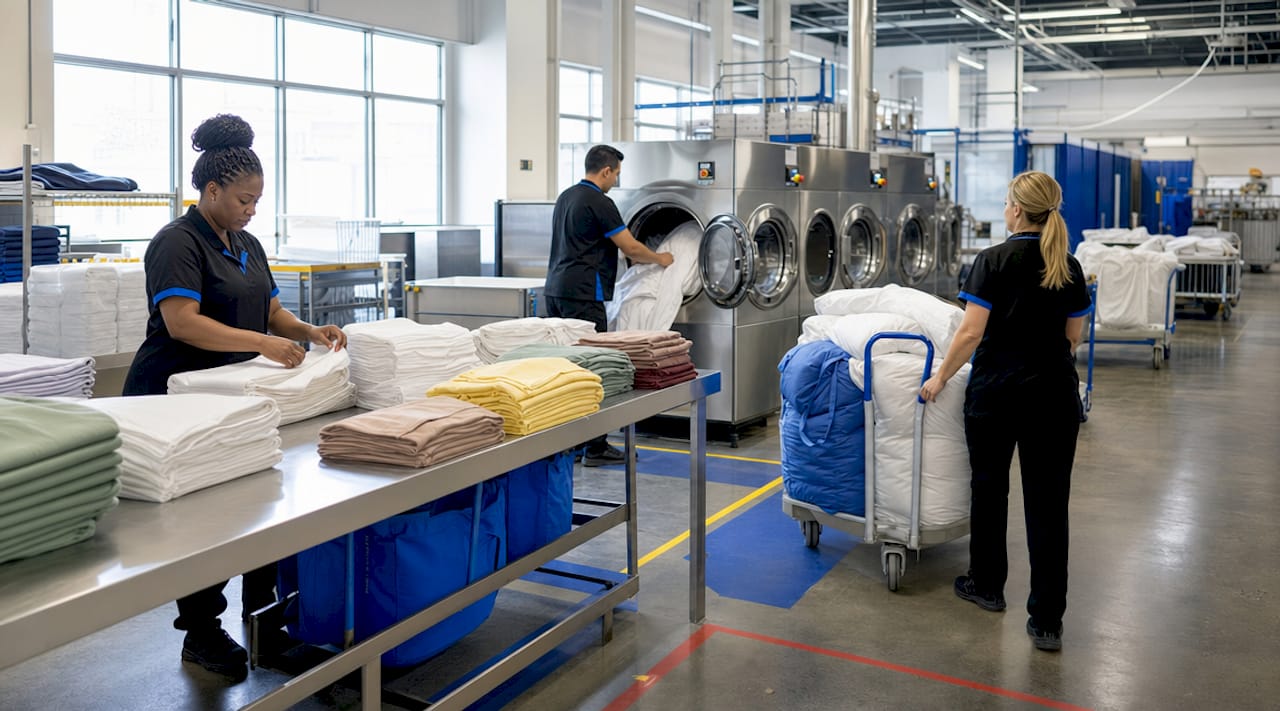
Labor costs at 40 to 60% of total expenses make workforce efficiency the single highest-leverage area in any commercial laundry operation. Cutting cycle time by even 10% across a full shift translates directly to more output per labor hour, which means lower cost per pound processed.
Here is a practical sequence for reducing both labor and utility costs without sacrificing quality:
- Measure cycle time at each stage. Time sorting, washing, drying, and finishing separately. Most managers assume the washer is the bottleneck. Often, it is the folding table. Measuring each stage with data from tools like Spinwashing’s industrial laundry guide reveals the real constraint.
- Match dryer capacity to washer output. Drying capacity should slightly exceed washing capacity to prevent a queue of wet loads sitting idle. A mismatch here creates a cascade of delays that no amount of extra staffing will fix.
- Switch wash temperatures where fabric care allows. The Department of Energy confirms that switching to warm water from hot cuts a load’s energy use by roughly half. For high-volume operations processing hundreds of loads per week, this is a meaningful reduction in utility spend.
- Clean moisture sensors on dryers regularly. Residue from detergents and fabric softeners degrades sensor accuracy, causing dryers to run longer than necessary. Regular cleaning and calibration extends equipment life and prevents energy waste from over-drying.
- Build a preventive maintenance schedule. Equipment downtime is a hidden labor cost. When a washer goes offline unexpectedly, staff stand idle or scramble to redistribute loads. A monthly maintenance checklist keeps machines running and protects your throughput.
Utilities typically represent 15 to 25% of commercial laundry costs. That figure is meaningful, but labor efficiency delivers faster and larger returns. Prioritize workflow improvements first, then layer in energy-saving equipment upgrades as capital allows.
What are the best practices for hygienic handling of clean laundry?
Clean linen can be re-contaminated after washing if stored or handled improperly. This is one of the most underestimated risks in professional laundry management, particularly in healthcare and hospitality settings where hygiene failures carry serious consequences.
The core principle is physical separation. Clean and soiled laundry must never share the same transport cart, storage shelf, or handling area. This is not just a policy recommendation. It is the operational design that prevents contamination from undoing every step of the wash process.
Environmental controls matter as much as handling procedures. Clean linen storage areas must be protected from dust, moisture, and foot traffic. Open shelving in a high-traffic corridor is a contamination risk regardless of how well the linen was washed. Covered shelving in a dedicated, low-traffic room is the standard that infection control professionals recommend.
- Separate transport: Use dedicated carts for clean linen only, clearly labeled and never used for soiled items.
- Covered storage: Store clean linen on covered or enclosed shelving to block dust and airborne particles.
- Minimize handling: Reduce the number of times clean linen is touched between folding and use.
- Control the environment: Keep storage areas dry, ventilated, and away from high-traffic zones.
- Special protocols for hazardous linen: Healthcare operations handling chemotherapy or drug-contaminated textiles must follow USP 800 protocols for safe management and staff protection.
Pro Tip: Treat your clean linen storage area with the same discipline as a food prep zone. If you would not prepare food there, you should not store clean linen there either.
How does technology transform laundry service optimization?
The shift from manual coordination to automated workflows is where commercial laundry solutions gain their biggest efficiency advantage. Laundry management software connects order intake, staff assignments, customer notifications, and payment processing into a single system that runs without constant manager intervention.
Platforms like Picky Assist demonstrate what this looks like in practice. WhatsApp automation handles customer engagement at every touchpoint: pickup confirmations, wash status updates, delivery alerts, and payment reminders. The result is a customer experience that feels attentive without requiring a staff member to send each message manually.
The comparison below shows the operational difference between manual and automated laundry management workflows:
| Function | Manual process | Automated process | Business impact |
|---|---|---|---|
| Order tracking | Paper logs or spreadsheets | Real-time digital dashboard | Fewer lost orders, faster resolution |
| Customer notifications | Phone calls or manual texts | Automated WhatsApp or SMS alerts | Lower staff workload, higher satisfaction |
| Payment processing | Invoice sent after delivery | Triggered automatically on order completion | Faster cash flow, fewer billing disputes |
| Staff coordination | Verbal handoffs between shifts | Centralized team inbox with order history | Consistent service across all shifts |
| Pickup scheduling | Phone or email booking | Online platform or app self-scheduling | Reduced booking errors, 24/7 availability |
The scalability argument for automation is straightforward. A manual system requires proportionally more staff as volume grows. An automated system absorbs additional order volume without a matching increase in headcount. For any business planning to grow its laundry service, technology is not a luxury. It is the infrastructure that makes growth financially viable. You can see how digital systems apply in practice by reviewing business laundry logistics in real service environments.
Key takeaways
Effective business laundry management requires integrating labor efficiency, equipment discipline, hygiene controls, and automation into a single coordinated system.
| Point | Details |
|---|---|
| Labor is the top cost driver | At 40 to 60% of total expenses, reducing cycle time and improving scheduling delivers the highest ROI. |
| Centralize with software | Laundry management systems like Picky Assist connect order tracking, communication, and payments in one place. |
| Hygiene requires physical separation | Clean and soiled linen must be separated by dedicated carts, storage areas, and handling procedures. |
| Match equipment capacity carefully | Drying capacity should slightly exceed washing capacity to prevent wet-load backlogs and idle staff time. |
| Automate customer communication | WhatsApp and CRM automation reduce manual follow-up and improve client retention without adding headcount. |
What I have learned from watching laundry operations succeed and fail
Most business owners who struggle with laundry operations are not failing because of bad equipment or poor staff. They are failing because they treat laundry as a background function rather than a managed process. The moment you start measuring cycle time at each stage, scheduling around volume data, and tracking orders digitally, the operation starts to look very different.
The contamination control piece is where I see the most dangerous blind spots. Managers invest in good washers and quality detergents, then store clean linen on open shelves in a hallway. The wash process was perfect. The storage undid it. Treating post-wash handling as an ongoing controlled process, not just a storage task, is the shift that actually protects your hygiene outcomes.
On the technology side, I would push back on the idea that automation is only for large operations. A small laundry service handling 50 orders per week still benefits from automated pickup confirmations and digital order tracking. The time saved on manual communication alone justifies the investment. And when you are ready to grow, the system scales with you instead of breaking under the load.
The businesses that get this right share one habit: they review their operations regularly and upgrade their systems before problems force them to. That discipline, more than any single tool or technique, is what separates a profitable laundry operation from one that is always catching up.
— Daniel
How Columbiapikelaundry supports your business laundry needs
If you are managing laundry for a business in the Arlington, Virginia area and want the operational discipline described in this guide without building it from scratch, Columbiapikelaundry offers a practical alternative. As a family-owned operation at 2602 Columbia Pike, every item is cleaned in-house, which means tighter quality control and direct accountability. Businesses can schedule pickup and delivery through the online platform or app, set custom preferences like fragrance-free detergents, and track order status in real time. With a standard 48-hour turnaround and express options available, Columbiapikelaundry removes the operational burden of laundry so your team can focus on the work that actually grows your business. Visit columbiapikelaundry.com to schedule your first pickup.
FAQ
What is business laundry management?
Business laundry management is the organized coordination of laundry workflows, staff, equipment, and customer communication to deliver consistent, cost-effective linen handling for commercial clients. It includes order tracking, hygiene protocols, equipment maintenance, and automation systems.
How much do labor costs affect commercial laundry profitability?
Labor costs represent 40 to 60% of total commercial laundry expenses, making workforce efficiency the single most impactful area for improving profitability. Reducing cycle time and aligning staff schedules with order volume are the fastest ways to lower cost per pound processed.
How can businesses prevent clean linen from being re-contaminated?
Clean linen must be stored in covered, dedicated areas separated from soiled items, with controlled environments that limit dust, moisture, and foot traffic. Physical separation of clean and dirty laundry at every stage, from transport carts to storage shelving, is the standard recommended by infection control specialists.
What does laundry management software actually do?
Laundry management software centralizes order processing, customer history, staff communication, and payment workflows into one platform. Systems like Picky Assist also automate customer notifications via WhatsApp, reducing manual coordination and improving order visibility across shifts.
Is outsourcing laundry a viable option for small businesses?
Outsourcing to a professional laundry service is a practical option for small businesses that lack the volume or capital to justify in-house equipment. A reliable laundry service for businesses provides consistent turnaround, quality controls, and pickup and delivery logistics without the overhead of managing staff and machines internally.
Free pickup, expert care, delivered back to your door.
Popular Blog Articles



Meet the Author
Daniel Logan didn’t start CPL because he loved laundry. He started it because his family was drowning in time debt, and laundry was one of the biggest weights.
Mornings were chaos with two kids under 5. Evenings felt like catch-up. And weekends? Gone to sorting socks and folding piles.
He knew his story wasn’t unique. So he built a business that gave families like his just a little bit of breathing room one load at a time.
With no laundry experience but deep tech skills, Daniel rolled up his sleeves, doing every job himself while building systems that turned it into a modern laundry service that saves customers time, simplifies their lives, and delivers reliability they can count on.
That’s where CPL began. Not from a playbook, but from pain. From one dad trying to buy back time: for himself, and for every household like his.
Free pickup, expert care, delivered back to your door.