
Business laundry logistics: Boost efficiency and reliability

Columbia Pike Laundry offers pickup & delivery across Northern Virginia.
TL;DR:
- Effective laundry logistics are vital for small businesses in Arlington, preventing operational disruptions and enhancing branding. Implementing structured collection schedules, inventory tracking, and emergency protocols streamlines operations, reduces costs, and improves staff morale. Partnering with local providers like Columbia Pike Laundry ensures reliable, customized service that supports growth and consistency.
Running a small business in Arlington means managing a hundred moving parts at once, and laundry is rarely at the top of anyone’s priority list. But when a restaurant server shows up in a stained uniform, a med spa runs out of clean towels mid-appointment, or a construction crew can’t find compliant work shirts on a Monday morning, the real cost of poor laundry logistics becomes impossible to ignore. Clean garments and linens aren’t just a nice-to-have. They are operational infrastructure, as critical as your scheduling software or your supply chain.
Key Takeaways
| Point | Details |
|---|---|
| Laundry is logistics | Managing uniforms and linens is a supply chain issue that affects daily business performance. |
| Smart inventory cuts costs | Monitoring PAR levels and digitizing tracking can save thousands in emergency orders and storage. |
| Optimized delivery matters | Well-planned pickup and delivery routes save time and keep operations smooth for your business. |
| Emergency ready | Dynamic scheduling helps you respond quickly to urgent laundry needs without major disruption. |
| Efficiency sets leaders apart | Industrial laundry best practices—systems and know-how—give even small businesses real operational advantages. |
Why laundry logistics matter for your small business
Most business owners think about laundry as a chore, something to deal with when things run low. That mindset creates the exact gaps that hurt operations. Uniforms and linens carry your brand on their sleeves, literally. They signal to customers that your team is professional, that your standards are high, and that your business is worth trusting. Beyond image, certain industries require clean, inspected garments for regulatory compliance. Food handlers, healthcare workers, and childcare staff all operate under guidelines that tie cleanliness directly to licensing.
Unmanaged laundry creates bottlenecks you don’t see coming until they hit hard. A staff member who can’t find a clean uniform delays opening. A salon that runs out of fresh towels mid-morning forces rushed decisions. A property management company scrambling for clean linens before a tenant move-in pays premium prices at the last minute. These small fires add up in labor hours, emergency costs, and customer-facing mistakes.
The true cost of laundry mismanagement isn’t the laundry bill. It’s the domino effect on your team’s time, your customer experience, and your operating budget.
The good news is that laundry logistics for small businesses can be systematized just like any other supply chain function. The businesses that get this right free up their managers to focus on what actually grows revenue.
Key signs your laundry logistics need a serious upgrade:
- Staff regularly arrive in wrinkled, stained, or mismatched uniforms
- You’re making unplanned runs to a laundromat more than once a month
- Linens or towels run out during peak service hours
- You have no clear count of how many garments or linens are in circulation
- Emergency purchases are eating into your supplies budget
Uniform-workwear programs from established providers typically include scheduled, recurring weekly delivery of hygienically laundered garments plus inspection and repairs/replacements as needed. That level of structure is exactly what small businesses need to build on, even if they’re working with a local partner rather than a national program.
Understanding the laundry delivery benefits available to small businesses is often the first step toward building a system that actually holds up under daily pressure.
Pro Tip: Track how many times per month someone on your team makes an unplanned laundry run. Multiply that by their hourly wage and travel time. Most business owners are shocked by the number.
Core pillars of effective business laundry logistics
With the stakes clear, let’s break down the logistics framework successful businesses use for laundry management. Whether you run a boutique hotel, a busy salon, or a food service operation, four pillars determine whether your laundry system supports or sabotages your business.
When choosing a business laundry logistics approach, treat the workwear and linen program as a supply chain with controls: regular collection schedules, hygiene and quality controls, accurate item tracking and inspection to avoid losses, and inventory planning to prevent stockouts that force costly emergency orders.
1. Collection schedules Predictability is everything. Designating specific pickup days and times means your staff knows when to have items ready, and your provider can plan routes efficiently. Irregular collections create bunching, where too many items arrive at once, causing delays in turnaround.
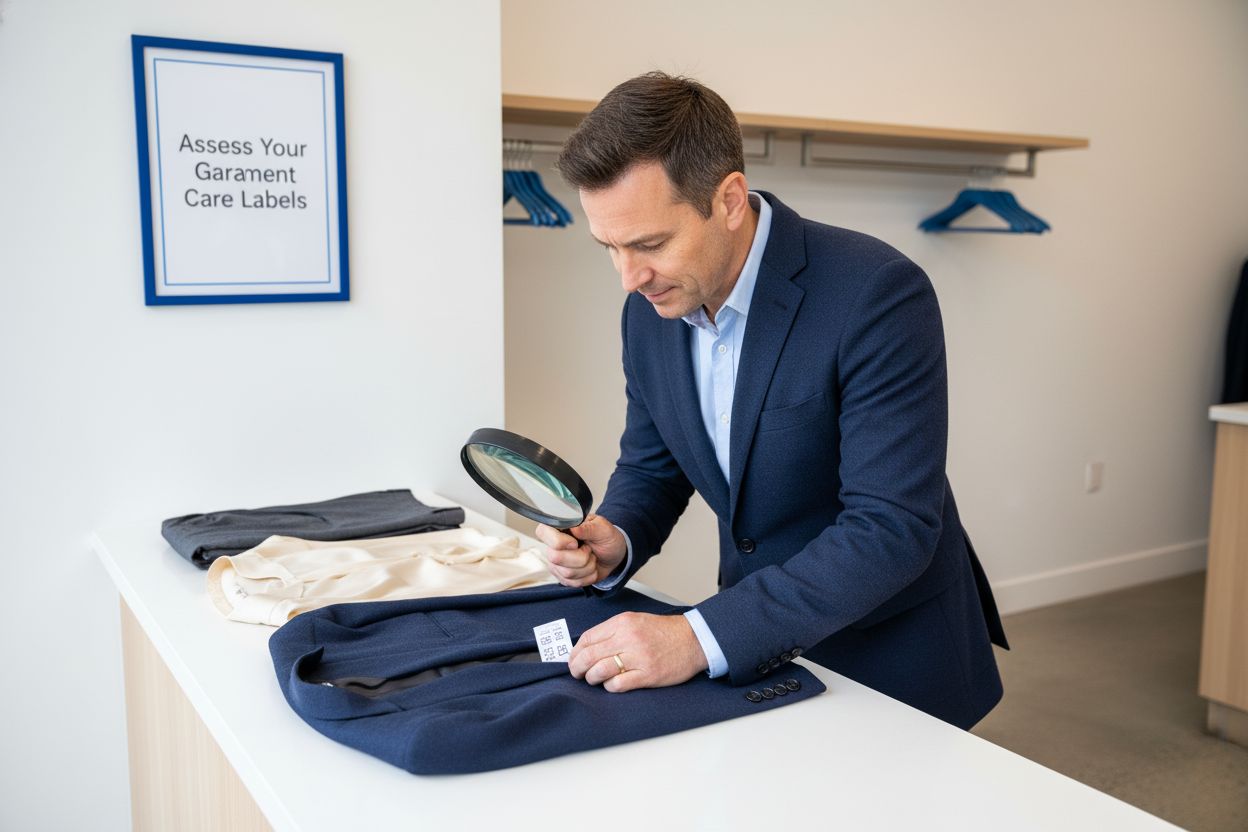
2. Quality and inspection controls Every item that goes out to your team should be checked before it’s returned to circulation. That means inspecting for stains, tears, missing buttons, and general wear. A worn collar or a fraying cuff sends a message to your customers that you’d rather not send. Building an inspection step into your process eliminates that risk.
3. Inventory tracking Manual tracking, typically a notebook or spreadsheet, works at very small scale but breaks down fast. Tech-enabled tracking, using barcodes, QR codes, or provider-managed software, gives you real-time visibility into what’s clean, what’s in transit, and what’s due for replacement.
| Feature | Manual tracking | Tech-enabled tracking |
|---|---|---|
| Setup cost | Low | Moderate |
| Accuracy | Variable | High |
| Time required | High | Low |
| Scalability | Poor | Excellent |
| Loss prevention | Limited | Strong |
4. PAR level planning PAR stands for Periodic Automatic Replenishment. It’s the minimum quantity of each item you need in circulation to cover demand without excess. Setting PAR levels for uniforms, towels, linens, and other items means you always have a buffer. Too few items causes stockouts; too many ties up cash and storage space.
Use our business laundry checklist to audit your current setup before building or adjusting your system. For a broader view of systems thinking, the laundry logistics overview breaks down how professional operations connect these pillars.
Optimizing pickup and delivery: Route planning tips
Strong logistics depend on smooth handoff and return. Now let’s tackle the most complex logistics challenge: efficient pickup and delivery. This is where most small operations leave significant time and money on the table.

The “pickup-and-delivery problem” is a well-studied challenge in supply chain management. It’s not simply about going from Point A to Point B. Pickups increase the load in a vehicle, clean items must be separated from soiled ones, and delivery sequencing must account for time windows at each stop. For pickup-and-delivery operations, route planning must account for time windows and capacity changes caused by each pickup and delivery along the route.
This matters for your business because a disorganized pickup schedule creates delays that affect your turnaround time. If your laundry provider is doing six pickups before processing yours, you’re waiting longer, and that affects your inventory.
Additionally, pickups and deliveries are not independent legs of a route. Capacity and sequencing constraints must be respected throughout because pickups increase load and clean items must only be delivered after appropriate processing is completed.
Here’s a practical sequence for optimizing your pickup-and-delivery arrangement:
- Identify your peak soiled-item windows. When do uniforms pile up? End of shift? End of the week? Knowing this helps set the ideal pickup time.
- Request consistent time windows. A two-hour delivery window beats a vague “sometime Tuesday,” especially if you have staff coverage to consider.
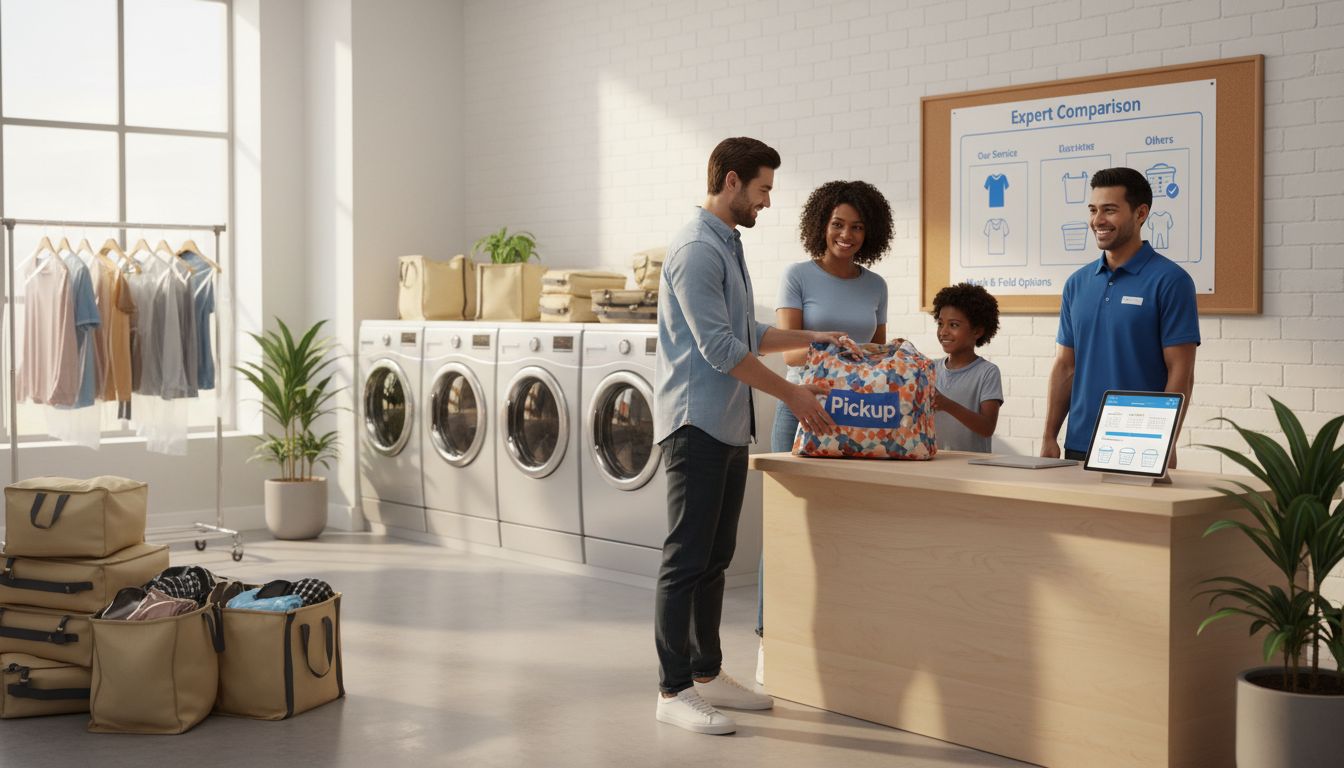
- Separate soiled from clean at the point of collection. Provide dedicated bags or bins so your provider’s driver doesn’t have to sort on-site.
- Build in a buffer day before your busiest service day. If Saturday is your busiest day, Thursday delivery of clean items is safer than Friday.
- Communicate changes proactively. If your volume spikes due to an event or seasonal rush, alert your provider at least 48 hours ahead.
| Scenario | Risk without planning | Outcome with planning |
|---|---|---|
| High-volume week | Late delivery, staff shortages | Buffer stock covers demand |
| Event catering | Emergency laundry run | Pre-arranged extra pickup |
| Equipment issue at provider | No clean uniforms Monday | PAR buffer prevents outage |
Pro Tip: Ask your laundry provider whether they use route optimization software. Providers that optimize routes are more likely to arrive on time and less likely to cancel or delay your pickup during busy periods.
The pickup and delivery guide gives a full breakdown of how to set this up from scratch. If you want to go deeper on the operational side, the delivery logistics workflow and best practices for laundry pickup are worth bookmarking.
Inventory management: The secret lever for cost savings
With deliveries optimized, the next frontier in reliable laundry logistics is smart inventory management. This is where many businesses can unlock real financial gains, and most of them don’t realize it until they’ve already spent years over-ordering or scrambling for stock.
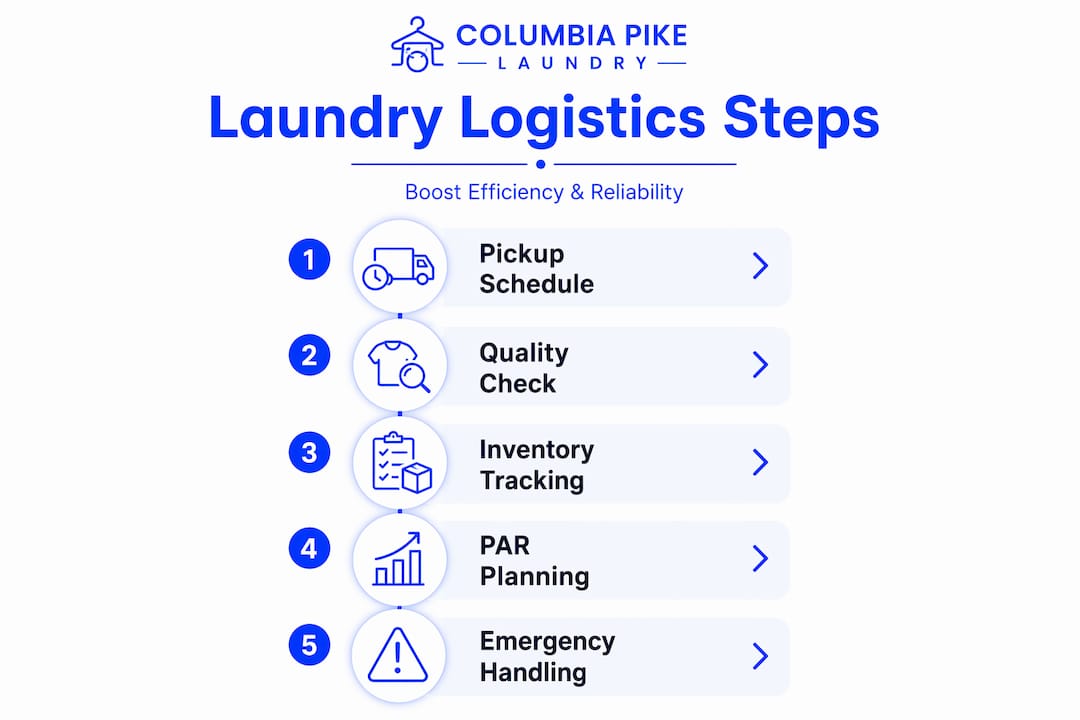
A core logistics methodology for business laundry is managing inventory and service levels through PAR planning to reduce emergency orders and excess linen needs. When you know exactly how many items are in each stage of your laundry cycle, clean, soiled, in-transit, and in-use, you eliminate the guesswork that leads to over-purchasing.
What good inventory management looks like in practice:
- Every item is tagged or labeled so it can be tracked individually
- You know the total number of each item category and where each one is at any given time
- Reorder thresholds are set in advance, not decided in a panic
- Replacement cycles are scheduled based on actual wear data, not gut feeling
- Your provider sends usage reports so you can spot trends before they become problems
The financial case for digitizing this process is compelling. Digitizing linen inventory and consumption enabled a reduction of PAR levels from 8 to 9 down to just 3 to 4, with reported procurement savings of approximately $40,000 to $60,000 per hotel per year. Even at a fraction of that scale, the same logic applies to a restaurant group, a spa chain, or a fitness studio. Fewer items in circulation means less storage, less loss, and less cash tied up in textile inventory.
Emergency orders are the budget killer that most owners chalk up to “just how it goes.” They are not. They are the symptom of a broken inventory system. With proper PAR tracking and a reliable provider, office laundry solutions can eliminate virtually all emergency purchasing by replacing reactive decisions with predictive restocking.
Responding to exceptions: Emergency requests and peak periods
Even the best systems face curveballs. Here’s how to stay prepared for unexpected logistical challenges without derailing your operations.
Static schedules work well under normal conditions. The moment something changes, a catering event, a staff illness, an unexpected busy weekend, they break down. Business laundry logistics should plan for exceptions like emergency and urgent pickup requests by using dynamic rerouting rather than relying only on static scheduled routes.
The most resilient businesses plan for exceptions before they happen. Here’s a simple playbook for staying operational under pressure:
- Map your peak periods now. Holiday seasons, local events in Arlington, restaurant weeks, graduation weekends. Mark them on your calendar and communicate them to your laundry provider at the start of each quarter.
- Establish an emergency pickup protocol with your provider. Know who to call, what lead time they need, and whether express turnaround is available. Having this in writing prevents confusion when you’re already stressed.
- Maintain a small emergency stock. Even with great PAR planning, keep a small reserve of your most critical items, typically five to ten percent above your standard PAR level, for true emergencies.
- Train a staff member to manage the laundry handoff. When the owner is unavailable, someone should know the schedule, the bag labeling system, and the provider’s contact information.
Understanding the role of pickup laundry in business continuity helps frame how central this function is to your daily operations.
Pro Tip: Create a simple one-page “laundry emergency card” for your team. Include your provider’s contact number, your PAR numbers for critical items, and the steps to request an urgent pickup. Laminate it. Put it where your laundry bags are stored.
Our take: What truly sets world-class business laundry logistics apart
Let’s step back and share what years in the business laundry logistics trenches actually teach you. Most articles on this topic stop at “find a reliable provider and set a schedule.” That’s table stakes. The businesses that truly get ahead of laundry as an operational function think about it the way industrial operations do: as a system where efficiency and process knowledge are the real differentiators, not just cleanliness.
Industrial and institutional uniform laundering emphasizes operational efficiency through systems and know-how as the primary differentiator, not cleaning quality alone. What does that mean for a small business in Arlington? It means that two providers can both return your uniforms clean, but the one with tighter tracking, predictable turnaround, transparent communication, and flexible emergency response is genuinely worth more to your operation.
We see small business owners make the same mistake regularly: they choose a laundry provider based on price alone, then lose far more money in disruptions, emergency orders, and staff time than they ever saved on the rate. The correct way to evaluate any provider is to ask how they handle your worst day, not your average Tuesday.
Another thing most guides miss: the relationship between your laundry system and staff morale. Employees who receive clean, pressed uniforms on time feel respected. That’s not soft talk. It’s a measurable driver of retention, and in Arlington’s competitive labor market, keeping good staff is one of the highest-ROI investments you can make. Building a reliable logistics in laundry delivery system signals to your team that you take operations seriously.
The businesses we see thrive are those that stop treating laundry as a nuisance and start treating it as a repeatable, improvable process. That shift in mindset is where the real gains live.
Enhance your laundry logistics with a local partner
Armed with this knowledge, here’s how you can put it into action in Arlington. Columbia Pike Laundry works directly with small businesses in the area to build laundry programs that fit your actual schedule, volume, and standards. Because we do all cleaning in-house at our 2602 Columbia Pike storefront, we control quality at every step, from wash temperature to folding method. There are no middlemen, no surprises, and no excuses. You can review how our service works and customize preferences like fragrance-free detergents or specific folding instructions. When you’re ready to see what reliable, local business laundry logistics looks like in practice, check our transparent pricing and schedule your first pickup through our app.
Frequently asked questions
What are PAR levels and why do they matter?
PAR levels, or Periodic Automatic Replenishment, are target inventory amounts ensuring you have enough clean linens or uniforms available while minimizing excess. Managing PAR levels is a core methodology for reducing emergency orders and keeping operations predictable without overstocking.
How do laundry logistics save my business money?
Efficient laundry logistics reduce emergency orders, prevent item loss, and optimize how many garments you actually need in circulation. Digitizing linen inventory alone has generated procurement savings of $40,000 to $60,000 annually in hospitality operations, with proportional gains available at smaller scale.
What should I look for in a business laundry provider?
Choose providers offering scheduled pickup and delivery, hygiene and quality controls, item tracking, flexible emergency response, and transparent pricing. Established uniform programs include recurring scheduled delivery, inspection, and repair services as standard features to benchmark against.
How can I handle emergency laundry needs quickly?
Work with providers who offer dynamic rerouting and on-demand service to handle urgent situations without disrupting your daily flow. Providers using dynamic rerouting for urgent pickup requests can respond far faster than those relying on fixed static routes alone.
Free pickup, expert care, delivered back to your door.
Popular Blog Articles



Meet the Author
Daniel Logan didn’t start CPL because he loved laundry. He started it because his family was drowning in time debt, and laundry was one of the biggest weights.
Mornings were chaos with two kids under 5. Evenings felt like catch-up. And weekends? Gone to sorting socks and folding piles.
He knew his story wasn’t unique. So he built a business that gave families like his just a little bit of breathing room one load at a time.
With no laundry experience but deep tech skills, Daniel rolled up his sleeves, doing every job himself while building systems that turned it into a modern laundry service that saves customers time, simplifies their lives, and delivers reliability they can count on.
That’s where CPL began. Not from a playbook, but from pain. From one dad trying to buy back time: for himself, and for every household like his.
Free pickup, expert care, delivered back to your door.