
Laundry for Sensitive Skin: Top Picks and Tips
Columbia Pike Laundry offers pickup & delivery across Northern Virginia.
TL;DR:
- Using fragrance-free, certified, and simple-formula detergents reduces skin irritation for sensitive skin. Proper washing habits, such as rinsing thoroughly and avoiding dryer sheets, significantly lower dermatitis risks. Consulting a dermatologist is advisable if reactions persist despite choosing safe laundry practices.
If your skin flares up after wearing freshly washed clothes, you already know the frustration. Laundry for sensitive skin is more than just picking a milder detergent. It’s about understanding what’s actually in your detergent, how you’re washing, and what touches your skin before it ever leaves the dryer. The wrong product can trigger rashes, eczema flares, or contact dermatitis even when your clothes look and smell perfectly clean. This guide covers what makes a detergent genuinely safe, the best options available in 2026, practical washing habits that reduce irritation, and when it’s time to see a dermatologist.
Key takeaways
| Point | Details |
|---|---|
| Choose fragrance-free, not unscented | Only "fragrance-free" guarantees no added scent chemicals that can trigger dermatitis or eczema flares. |
| Look for NEA or NPF certification | These seals confirm independent dermatological review, offering more protection than any marketing claim. |
| Avoid overdosing your detergent | Excess detergent leaves residue on fabric that irritates skin, even with gentle formulas. |
| Skip dryer sheets entirely | Chemical coatings in dryer sheets penetrate fabric fibers and cause chronic skin irritation. |
| Shorter ingredient lists are safer | Fewer ingredients mean fewer chances of unknown allergen exposure for reactive skin. |
1. What to look for in laundry detergents for sensitive skin
Not all “gentle” detergents are created equal. Brands spend heavily on marketing words like “pure,” “natural,” and “clean.” None of those words have a regulated definition. Here’s what actually matters.
Fragrance-free vs. unscented. This distinction trips up most shoppers. Many assume “unscented” means safe, but unscented products often contain masking fragrances to neutralize chemical odors. Those masking agents are still scent chemicals and still trigger dermatitis. “Fragrance-free” means no added scent compounds at all. That’s the label you want.
Dye-free formulas. Synthetic dyes give detergent its blue or purple color and serve zero cleaning purpose. They cling to fabric fibers and press directly against your skin with every wear.
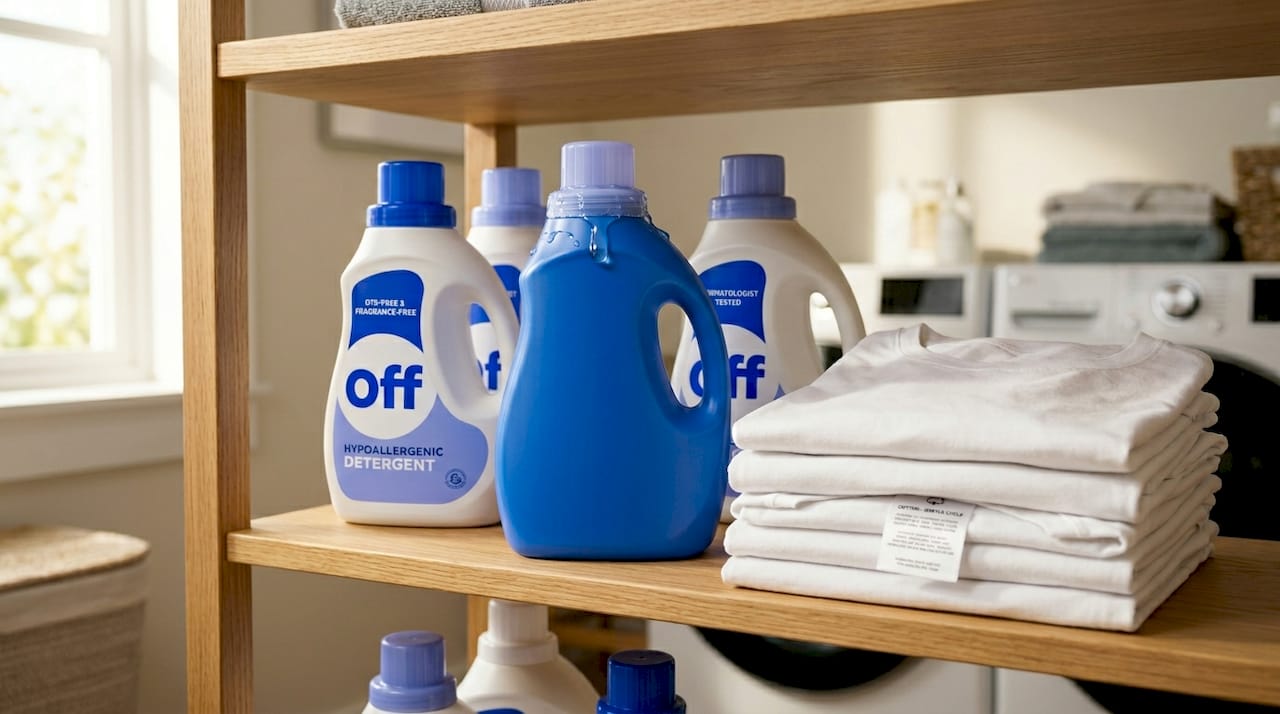
Certification seals. The National Eczema Association (NEA) and National Psoriasis Foundation (NPF) both operate independent review programs. NPF-certified detergents go through lab testing and expert panels to verify safety for psoriatic skin. That’s a higher bar than anything a brand can print on its own label.
Optical brighteners. These UV-reactive chemicals make white fabrics appear whiter under light. They don’t rinse out fully and stay active against your skin. Avoid them.
Short ingredient lists. Minimal, transparent ingredients reduce the risk of unknown allergen exposure. The more ingredients, the more chances one of them reacts with your skin.
Pro Tip: Run an extra rinse cycle after every wash. It removes residual detergent from fabric, which is one of the most overlooked causes of irritation even with gentle formulas.
2. All Free Clear
All Free Clear is the detergent most dermatologists reach for when recommending a starting point. It contains no fragrances, no dyes, and no optical brighteners. It’s also widely available at most grocery and big-box stores, which matters when you need to replace a bottle quickly.
The formula cleans everyday stains well without requiring a higher-than-normal dose. It works in both standard and high-efficiency machines. For anyone new to allergy-friendly laundry products, this is the most accessible starting point.
3. Tide Free & Gentle
Tide Free & Gentle carries the NEA seal and holds up well against tougher stains compared to many gentler alternatives. If you’ve been avoiding Tide because of scent associations, this version is genuinely different. No fragrance, no dye, no brighteners.
The NEA and NPF seals provide verification that no marketing claim can match. Tide Free & Gentle is one of the few widely available detergents that earns both strong cleaning reviews and dermatological backing. It’s a reliable pick for eczema-prone skin.
4. Seventh Generation Free & Clear
Seventh Generation uses plant-based surfactants and skips synthetic fragrances entirely. It’s a strong option for people who want natural laundry products for sensitive skin without sacrificing cleaning performance on sweat and light food stains.
One caution: not every “eco-friendly” formula is automatically hypoallergenic. Some plant-based detergents include irritating essential oils or botanical additives. Seventh Generation Free & Clear avoids those additions, which is why it stands out in the plant-based category.
5. Puracy Natural Liquid Laundry Detergent
Puracy keeps its ingredient list short and transparent, which is the standard everyone else should be held to. It’s plant-derived, enzyme-based, and free of sulfates, synthetic fragrances, and dyes. Pre-measured pods or pump dispensers help avoid the dosing errors that turn even gentle detergents into irritants.
It’s a particularly good option for parents managing laundry care for eczema in children, where both cleaning power and gentleness matter equally. The liquid format dissolves completely in cold water, which reduces residue risk on thinner fabrics.
6. Molly’s Suds Original Laundry Powder
Powder detergents get overlooked, but they often have shorter ingredient lists than liquid counterparts. Molly’s Suds uses just a handful of ingredients: sodium carbonate, magnesium sulfate, and a few plant-based additions. No dyes, no synthetic fragrance, no fillers.
If you have hard water, powder can be slightly tricky since it needs adequate water temperature to dissolve fully. A short warm pre-rinse before switching to cold solves that. The low-ingredient formula makes it one of the better hypoallergenic laundry options for people reacting to everything else they’ve tried.
7. Arm & Hammer Sensitive Skin Free & Clear
This is the budget-friendly pick that still delivers. No fragrance, no dyes, and a formula gentle enough for daily washing of sensitive skin fabrics. It’s not the strongest stain fighter for heavy soil, but for everyday clothing and bedding, it performs reliably.
The affordability makes it practical for families doing high-volume laundry. It’s also widely stocked, so you’re not dependent on online ordering or specialty stores.
8. Dropps Sensitive Skin Pods
Pods solve one of the most consistent problems in sensitive skin fabric care: accidental overdosing. Overdosing detergent builds up residue on fabrics that irritates skin, even when the formula itself is gentle. Dropps pre-measures the right amount so that variable never works against you.
The pods are fragrance-free, dye-free, and biodegradable. They also dissolve well in cold water, which matters because cold washing is better for both sensitive skin and fabric longevity. A good pick for people who want a simple, low-decision laundry routine.
9. Biokleen Free & Clear Laundry Powder
Biokleen’s formula is free of synthetic fragrance, dye, phosphates, and preservatives. It uses enzymes to break down protein-based stains like sweat and food without needing harsher chemicals. The powder format keeps the formula stable without the preservatives liquid versions often require.
For anyone managing laundry care for eczema alongside environmental concerns, Biokleen hits a solid middle ground. It’s concentrated, so the cost per load stays reasonable despite the higher upfront price.
10. Attitude Little Ones Baby Laundry Detergent
This one is marketed for infants, but it’s just as appropriate for adults with reactive skin. Safe laundry detergent for infants has to meet a high standard, and Attitude clears it: no synthetic fragrance, no dye, no phosphates, and it’s EWG-verified.
EWG verification means every ingredient has been assessed for safety and transparency. That level of ingredient scrutiny is exactly what you want when your skin reacts to products others tolerate without issue.
11. A comparison of top gentle detergents
| Detergent | Fragrance-free | Dye-free | Certification | Format | Best for |
|---|---|---|---|---|---|
| All Free Clear | Yes | Yes | NEA | Liquid | Everyday use, budget-friendly |
| Tide Free & Gentle | Yes | Yes | NEA | Liquid / Pods | Tougher stains, eczema |
| Seventh Generation F&C | Yes | Yes | None listed | Liquid | Plant-based preference |
| Puracy Natural | Yes | Yes | None listed | Liquid | Kids, eczema, minimal ingredients |
| Molly's Suds | Yes | Yes | None listed | Powder | Ultra-minimal ingredients |
| Dropps Sensitive | Yes | Yes | None listed | Pods | Dosing accuracy, convenience |
| Attitude Little Ones | Yes | Yes | EWG Verified | Liquid | Infants, highly reactive skin |
12. Best washing habits for sensitive skin
Choosing the right detergent is only half the equation. How you wash matters just as much.
Drop the dryer sheets. Chemical coatings in dryer sheets penetrate fabric fibers and cause chronic skin irritation. This isn’t a minor risk. Many people who switch detergents and see no improvement are still using dryer sheets. Wool dryer balls are an effective, chemical-free replacement that also reduces static and drying time.
Wash in cold water on a gentle cycle. Cold water is less aggressive on fabric fibers, which means fewer microscopic breaks in the material that can snag and irritate skin. A gentle cycle also reduces mechanical stress on clothing.
Add an extra rinse. Most machines offer this as a setting. Using it consistently removes residual detergent that a single rinse leaves behind, particularly in high-efficiency machines with lower water volumes.
Adjust for water hardness. Hard water users often need a slightly higher detergent dose to achieve full cleaning and complete rinsing. A small amount of white vinegar in the rinse cycle helps neutralize mineral buildup that aggravates sensitive skin.
Choose skin-friendly fabrics. Cotton and bamboo breathe well and hold fewer irritants than synthetic fibers. When possible, prioritize these for items with extended skin contact like bedsheets, pajamas, and underwear. For more options on pairing your fabric choices with the right conditioner, the best fabric conditioner guide from Columbiapikelaundry covers this well.
Pro Tip: Pre-treat stains with a tiny amount of your gentle detergent directly on the fabric rather than reaching for stain sprays, which often contain alcohol, synthetic fragrance, or bleach alternatives that irritate reactive skin.
13. How to test a new detergent safely
Switching detergents when your skin is already reactive requires patience. A bad reaction to a new product can be hard to trace if you’ve changed too many variables at once.
Start by washing one or two items with the new detergent and wearing them for a full day before committing to washing everything. Watch for redness, itching, or raised patches, especially in areas where fabric sits closely against skin like waistbands, collar lines, and wrist cuffs.
If a reaction occurs, don’t assume the whole category is off-limits. Experts recommend avoiding bleach, synthetic fragrances, and sulfates as starting points for elimination. Narrow down the variable by checking whether the reaction tracks to a specific ingredient using the product’s full ingredient list.
See a dermatologist if:
- Reactions persist despite switching to certified fragrance-free detergents
- You develop hives, blistering, or swelling after wearing washed clothing
- Skin conditions like eczema or psoriasis worsen noticeably after laundry changes
- You can’t identify a consistent trigger despite careful elimination
A patch test done in a clinical setting can pinpoint specific allergens, which makes future product selection much more precise.
My honest take on laundry for sensitive skin
I’ve read through hundreds of product labels at this point, and the clearest lesson I’ve taken from it is this: marketing language is genuinely dangerous for people with reactive skin. “Gentle,” “pure,” “natural,” and “hypoallergenic” are not regulated terms. Any brand can print them without meeting a single external standard.
What I’ve found actually changes outcomes is ingredient transparency and third-party certification. When I see an NEA or NPF seal, I trust it more than five pages of brand claims because those seals require independent review. When I see a detergent with fewer than ten ingredients and every one of them is named clearly, I trust that more than a formula described only as “plant-based.”
The overdosing issue is also massively underestimated. I’ve seen people switch to the gentlest detergent on the market and still react because they’re using twice the necessary amount. The residue is the problem, not just the formula. Use pods, use the measuring line, or use less than you think you need. Then add that extra rinse.
The other thing I’d push back on is the assumption that switching detergents is enough. Dryer sheets, fabric softeners, and even the water quality in your home all contribute. The detergent gets the attention, but it’s often the dryer sheet that’s been the problem all along.
— Daniel
How Columbiapikelaundry handles laundry for sensitive skin
If managing all of this at home feels like a lot, Columbiapikelaundry offers a better option for Arlington, Virginia residents. As a family-owned operation at 2602 Columbia Pike, every item is cleaned in-house, which means real control over which products touch your clothes. You can request fragrance-free and dye-free detergents specifically, and those preferences are recorded and applied to every order.
Whether you drop off at the storefront or use the pickup and delivery service, you get professional handling without the guesswork. There’s no middleman routing your clothes through an unknown facility. Schedule through the app, set your detergent preferences, and get your laundry back within 48 hours, folded and ready. For anyone managing eczema, psoriasis, or general skin sensitivity, that level of control is worth a lot. Learn more about sensitive skin laundry care at Columbiapikelaundry.com.
FAQ
What detergent is best for sensitive skin and eczema?
Dermatologists most often recommend fragrance-free, dye-free formulas carrying the NEA seal, such as Tide Free & Gentle or All Free Clear. These avoid the most common chemical irritants without sacrificing cleaning performance.
Is “unscented” safe for sensitive skin?
No. Unscented products often contain masking fragrances that neutralize chemical odors and can still trigger dermatitis. Always choose products labeled “fragrance-free” instead.
How much detergent should I use for sensitive skin?
Use the minimum recommended dose or slightly less, and always run an extra rinse cycle. Overdosing detergent leaves residue on fabric that irritates skin even when the formula itself is gentle.
Can fabric softeners cause skin reactions?
Yes. Many fabric softeners and dryer sheets contain chemical coatings that stay active in fabric fibers after drying. Switching to wool dryer balls eliminates this risk entirely.
Are plant-based detergents automatically safe for sensitive skin?
Not always. Some plant-based formulas include essential oils or botanical additives that irritate reactive skin. Check the full ingredient list and look for a third-party certification rather than relying on “natural” labeling.
Free pickup, expert care, delivered back to your door.
Popular Blog Articles




Meet the Author
Daniel Logan didn’t start CPL because he loved laundry. He started it because his family was drowning in time debt, and laundry was one of the biggest weights.
Mornings were chaos with two kids under 5. Evenings felt like catch-up. And weekends? Gone to sorting socks and folding piles.
He knew his story wasn’t unique. So he built a business that gave families like his just a little bit of breathing room one load at a time.
With no laundry experience but deep tech skills, Daniel rolled up his sleeves, doing every job himself while building systems that turned it into a modern laundry service that saves customers time, simplifies their lives, and delivers reliability they can count on.
That’s where CPL began. Not from a playbook, but from pain. From one dad trying to buy back time: for himself, and for every household like his.
Free pickup, expert care, delivered back to your door.