
Towels smell after wash: Fix Towels Smelling After Wash: Exp
Columbia Pike Laundry offers pickup & delivery across Northern Virginia.
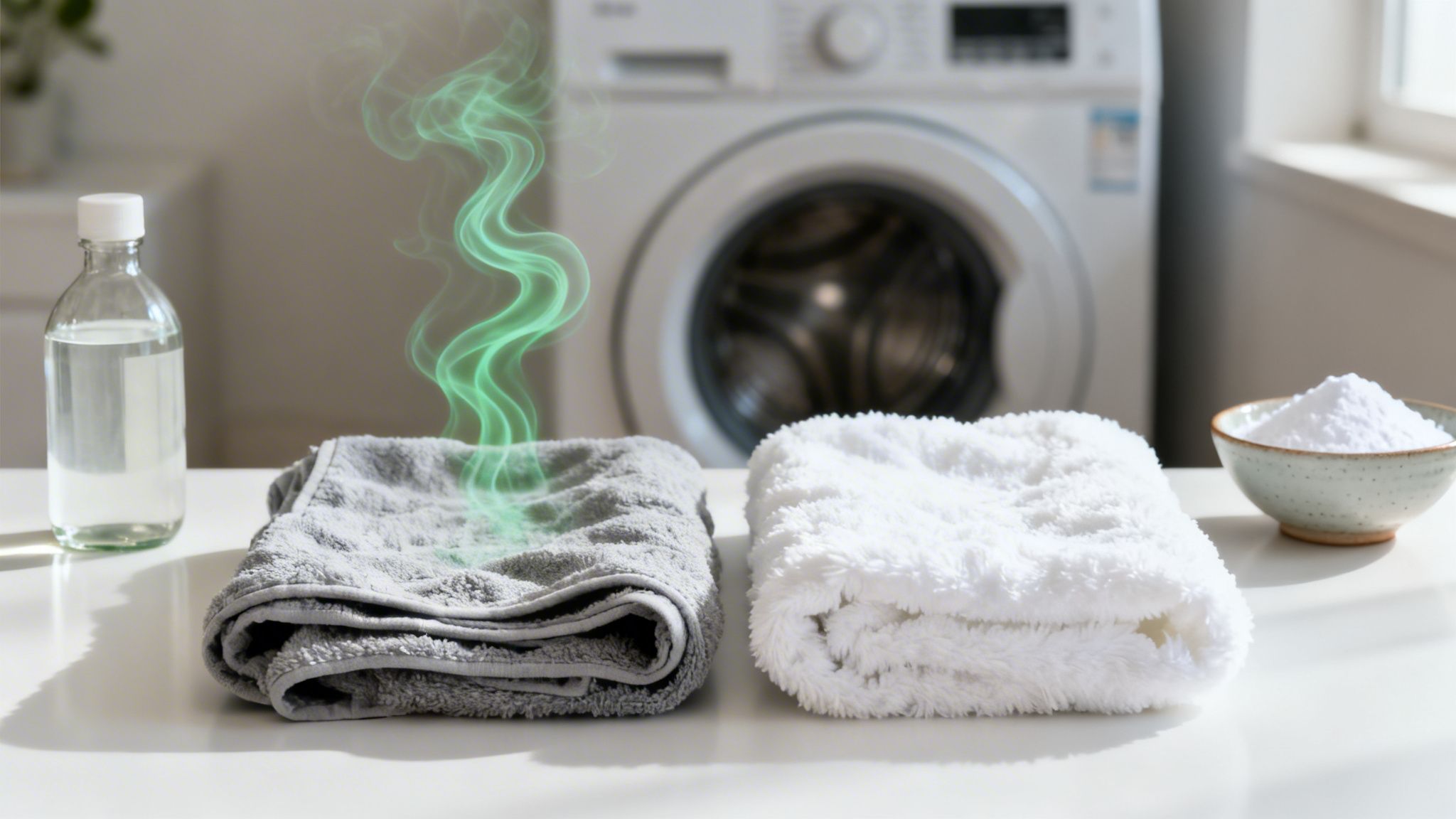
You know the moment. A towel comes out of the dryer warm, fluffy, and technically clean. Then you hold it to your face and catch that sour, stale smell that says something went wrong.
It is one of the most annoying household problems because it feels irrational. You washed the towels. You dried the towels. You did the chore. And somehow the towels smell after wash anyway.
The good news is that this is usually not about having a dirty home. It is about chemistry, moisture, and bad laundry habits that many normal households fall into without realizing it. Once you understand the pattern, the fix gets much simpler.
That Familiar 'Clean but Not Fresh' Smell
A lot of people blame the wrong thing first. They assume the towels are old, or the detergent is cheap, or somebody in the house is just careless.
Usually, that is not the core problem.
The more common story goes like this. You shower, use the towel, hang it up quickly, and move on with your day. Later it gets tossed in a hamper a little damp. Then it sits in the washer a bit too long. Then you wash it with too much detergent because you want it extra clean. Then you dry a crowded load and fold everything while the thickest towels still hold a little moisture in the center.
That is how a “clean” towel starts smelling wrong.
The smell is not just surface dirt. It is often bacterial growth living deep in the loops of the fabric, along with residue that your machine never fully rinsed away. Towels are excellent at holding water. Unfortunately, they are also excellent at holding onto body oils, skin cells, detergent film, and dampness.
That combination creates the classic musty towel problem.
Key takeaway: If your towels smell after wash, stop treating it like a mystery. It is usually trapped moisture plus residue plus bacteria, not a failure of effort.
I like to be direct about this because people waste a lot of time trying perfume-style fixes. Scent boosters, more softener, more detergent. Those usually make the problem worse.
You do not need stronger fragrance. You need a reset.
The Hidden Science Behind Smelly Towels
The smell comes from what is happening inside the towel, not just on it.
Towel odor results from biofilm formation within fabric loops rather than surface dirt, and damp towels give bacteria the moisture and food they need to build those colonies deep in the fibers. The same source notes that towel fibers trap skin cells and body oils, and that combining hot water cycles above 130°F with vinegar treatment every third to fourth wash achieves 90%+ odor elimination in affected towels (shopmavwicks.com).
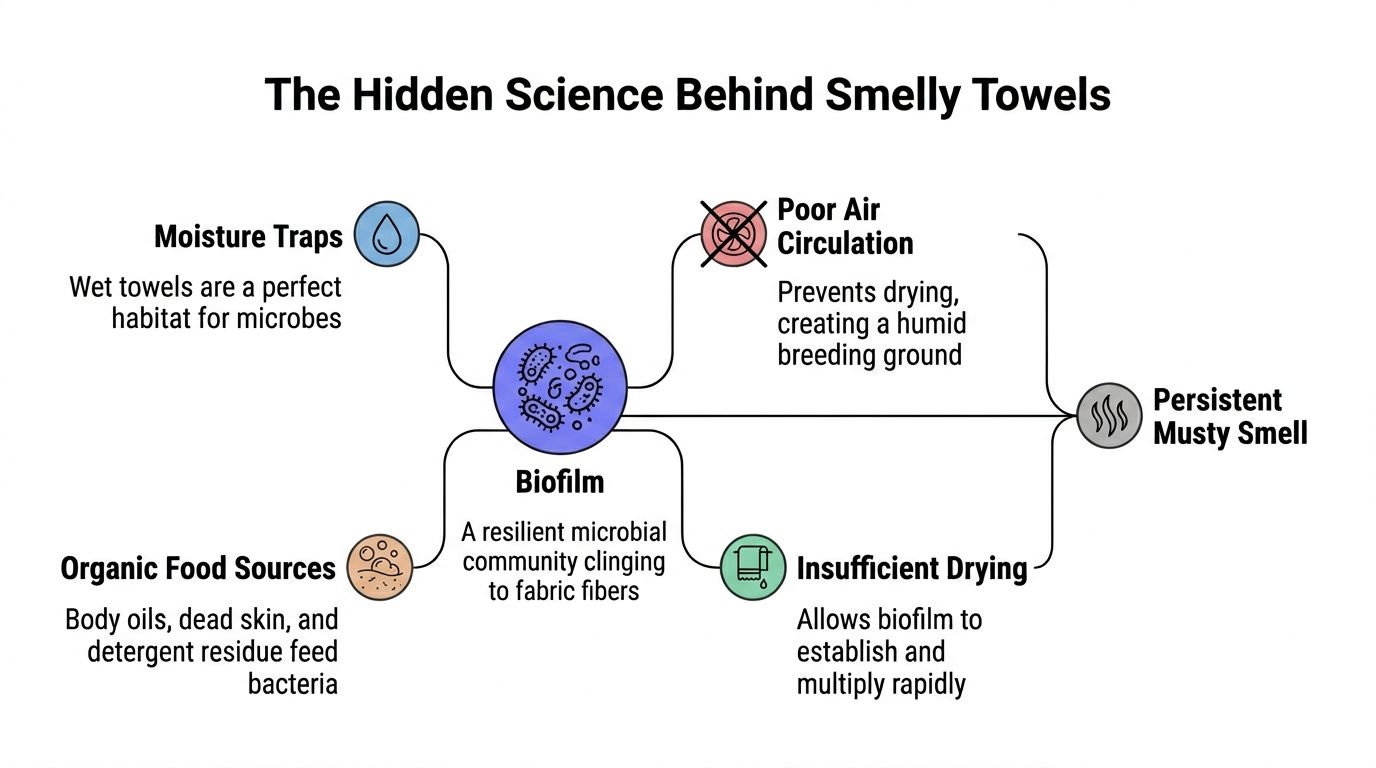
Biofilm is the primary villain
Think of biofilm as a stubborn microbial neighborhood. Once it forms, a normal wash cycle may freshen the surface but leave the deeper problem behind.
That is why towels can smell fine when they come out of the dryer, then smell sour again the minute they get damp. The odor did not disappear. It was waiting.
One bacterium often associated with that musty towel smell is Moraxella osloensis. It thrives when a towel stays damp long enough for odor compounds to build up.
Residue turns towels into odor traps
The next problem is buildup.
If you use too much detergent, or use fabric softener regularly, you leave a coating on the towel fibers. That coating makes towels less absorbent, slower to dry, and more likely to trap smells. Instead of helping, the product starts feeding the cycle.
A towel that cannot release moisture quickly becomes a perfect home for odor.
Hard water can make it worse
In some homes, minerals in the water cling to soap residue and stay in the fabric. That leaves towels feeling stiff, less absorbent, and harder to rinse clean.
You may notice this if your towels smell wrong even when your washing routine seems reasonable. It is not always your technique. Sometimes your water is part of the problem.
The bathroom itself may be helping the smell
A humid bathroom is a bad storage environment for towels. Clean towels absorb moisture from the air. Used towels dry more slowly. Hooks bunch fabric together. Steam lingers. The whole room works against freshness.
If you have any reason to suspect the issue goes beyond laundry and into household moisture, it helps to understand mold in your home so you can separate a towel problem from a larger ventilation problem.
Here is the short version of the science:
| Problem | What it does |
|---|---|
| Biofilm | Protects bacteria inside the fabric loops |
| Detergent residue | Traps oils, moisture, and odor |
| Fabric softener | Coats fibers and slows drying |
| Humidity | Keeps towels damp longer |
| Hard water | Makes buildup harder to rinse away |
The mystery is not why towels smell. The mystery is why so many laundry routines still ignore the actual causes.
Your Towel Rescue Protocol A Deep Cleaning Guide
If your towels already smell bad, you need a reset strong enough to strip away buildup and break the odor cycle.
This is the practical fix I recommend first. It is simple, it is cheap, and it addresses the most common cause directly.
Soap residue accumulation is the most common preventable cause of post-wash towel odors, and overuse of detergent or fabric softener can reduce towel absorbency by up to 40%. The same source says targeted vinegar and baking soda cycles can deliver 85-95% remediation success by breaking down the buildup left behind on fibers (homestolove.com.au).
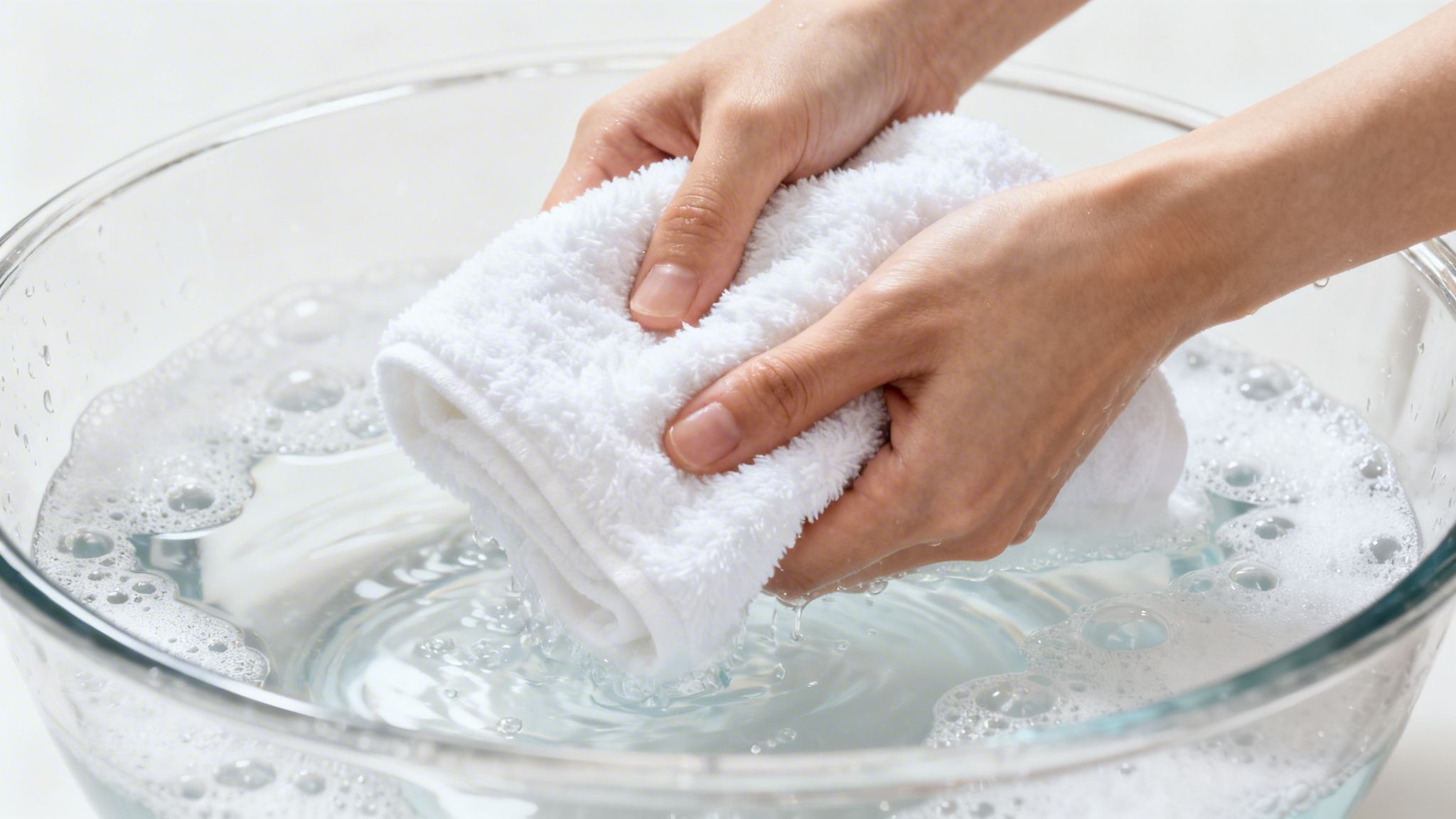
First wash with vinegar only
Put only the towels in the machine. No clothes, no bath mats, no mixed load.
Run a hot wash with white vinegar and no detergent. This first cycle helps loosen soap film, mineral deposits, and the residue that keeps odors stuck in the fabric.
Do not crowd the drum. Towels need room to move.
Second wash with baking soda only
Leave the towels in the machine.
Run another hot cycle with baking soda and no detergent. This helps neutralize odor and lift out what the first cycle loosened.
Keep it simple. No scent beads. No softener. No extra soap “just in case.”
Tip: Never mix vinegar and baking soda in the same cycle. They work better as separate steps.
Dry them completely, not mostly
This part matters more than people think.
Dry the towels until they are fully dry all the way through. Not warm. Not almost dry. Not “good enough.” Thick towels can still be damp in the center when the outer surface feels finished.
If you fold them while any moisture remains, you undo your own work.
What to avoid during the reset
A rescue wash fails when people add too many extras. Keep the process stripped down.
- Skip detergent: Your towels already have enough residue.
- Skip fabric softener: It adds coating right back onto the fibers.
- Skip overloaded loads: Crowding prevents proper agitation and rinsing.
- Skip the sniff-and-fold shortcut: Dryness matters more than surface warmth.
When one reset is not enough
If the towels have been smelly for a long time, one treatment may improve them without fully solving them. Repeat the process if needed.
Some towels recover beautifully. Some have been coated and rewetted so many times that they never fully bounce back. If they smell sour again immediately after a proper reset, the fibers may be too far gone.
If you want a more detailed look at the method, this walkthrough on laundry stripping gives you a clear reference point.
A rescue cycle is your reset button. It does not just make towels smell nicer. It restores absorbency, improves drying, and gives you a clean baseline so your regular routine can work.
Building a Stink-Proof Laundry Routine
Once your towels are reset, the next job is prevention.
A lot of towel problems return because people deep-clean the fabric but keep the same habits that caused the smell in the first place. If your washer stays grimy, your loads stay crowded, and your towels sit damp for hours, the smell comes back.
A useful reality check comes from a 2019 study by Charles Gerba. It found that 93% of freshly laundered cloth towels used in hospital rooms harbored potentially harmful bacteria, despite hot water and bleach protocols, which shows how hard moisture-related contamination is to beat when drying and handling fall short (microban.com).
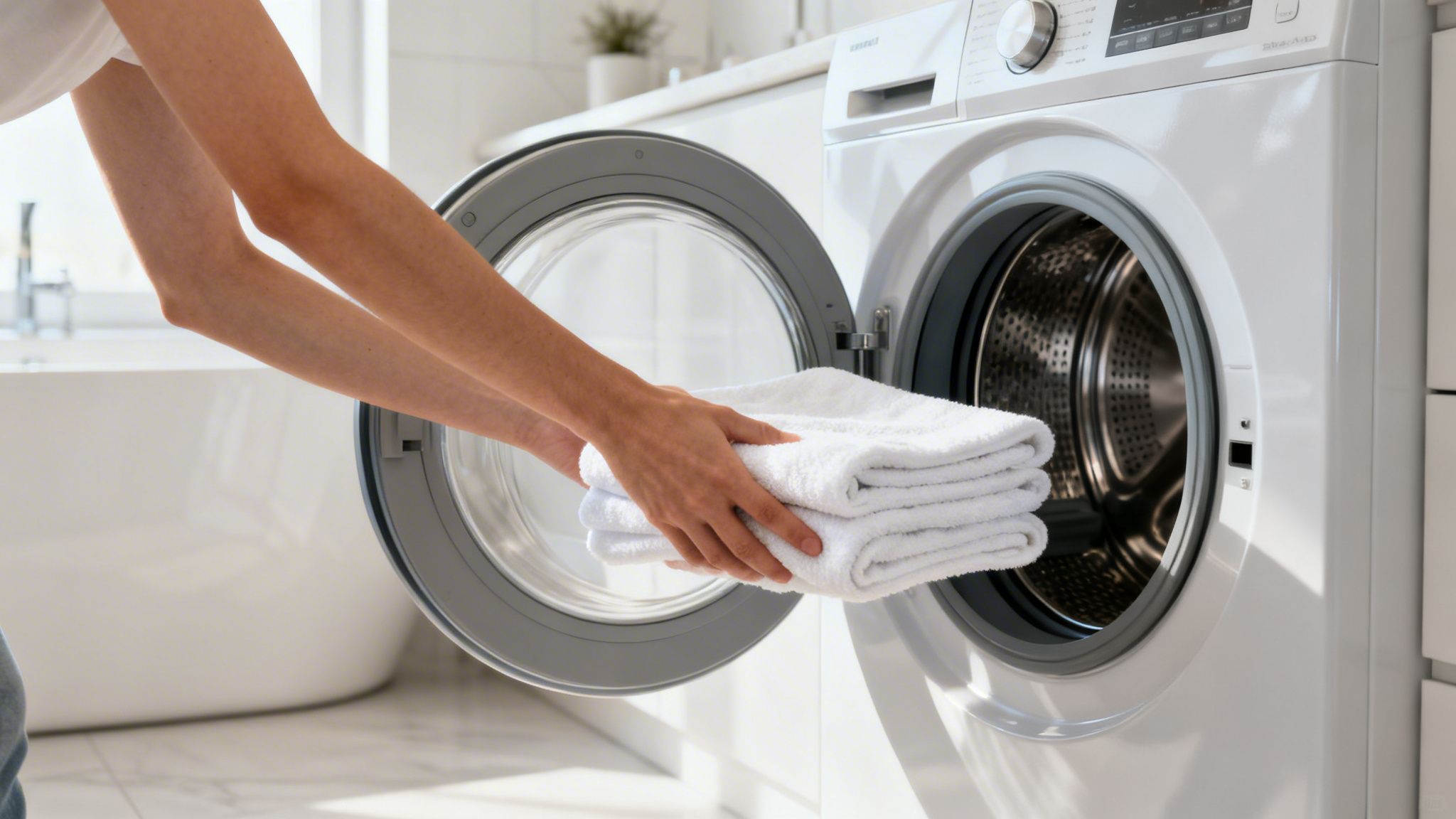
Treat the washer like part of the problem
If your machine smells, your towels will eventually smell too.
Front-load gaskets are especially good at hiding moisture, lint, and moldy residue. Pull back the rubber seal and wipe it. Clean the detergent drawer. Run an empty hot cycle regularly to flush out buildup.
If your washer door can stay open between loads, leave it open so the drum can dry.
Change how you wash towels
Towels are not regular laundry. They need their own rules.
- Use less detergent: More soap does not mean cleaner towels.
- Wash towels separately: They need room and a stronger rinse.
- Use hot water when the care label allows: Heat helps disrupt odor-causing buildup.
- Move fast after the wash: Do not let wet towels sit in the machine.
Drying: A Common Failure Point
This is the quiet failure point.
Towels look dry before they are dry. That is why people fold them too early, stack them too soon, and create a fresh round of odor before the towels ever reach the closet.
A good routine is boring, and that is exactly why it works.
A simple weekly rhythm
You do not need a complicated system. You need consistency.
| Habit | Why it works |
|---|---|
| Wash towels in their own load | Better agitation and rinsing |
| Use a modest amount of detergent | Less residue left in the loops |
| Dry immediately after washing | Prevents damp recontamination |
| Check thick towels by hand | Catches hidden moisture before folding |
Practical rule: If a towel feels cool in the center after drying, keep drying it.
Do not let damp towels wait anywhere
Not in the hamper. Not in the washer. Not in a heap on the floor. Not folded on a chair.
Moisture plus time is what gives bacteria the opening they need. If you stop giving them that opening, your laundry gets easier fast.
A stink-proof routine is not glamorous. It is just disciplined. But once you build it, towels stop being one of those household chores that keep reappearing like a bad joke.
Choosing the Right Products and Storage
The products you use matter. The place you keep the towels matters too.
Many people focus only on detergent, but storage conditions can undo a perfectly good wash. A humid bathroom encourages odor. A heavily perfumed softener leaves buildup behind. A packed linen shelf traps dampness.
That is why this is partly a laundry problem and partly a lifestyle problem.
Bathrooms are naturally humid environments that breed odor-causing bacteria, and towels do better in well-ventilated storage than in the bathroom itself. That is one reason pickup-and-delivery laundry services can act as a form of environmental control for busy households that lack ideal storage space (trulyfreehome.com).
What to stop buying for towels
Some products sound helpful but sabotage towels over time.
Liquid fabric softener is the biggest one. It coats fibers. That coating makes towels feel smooth at first, then less absorbent and slower to dry. The short-term fluff comes at the cost of long-term freshness.
Heavily scented detergents can also fool you. They may cover mild odor for a while without fixing residue or moisture.
Better choices that keep towels cleaner
I prefer simple products for towels.
- Free & Clear detergent: Better if you want less residue and fewer competing fragrances.
- White vinegar in the rinse process: Useful for periodic odor control.
- Wool dryer balls: They improve airflow without coating the fabric.
- No softener sheets on every load: Save them for items that are not meant to absorb water.
Storage habits that help instead of hurt
Used towels should hang open, not bunched up.
A towel bar is better than a hook because more surface area gets air. If you only have hooks, spread the towel out as much as possible. If your bathroom stays steamy, run the fan longer or move the towel to a drier area.
Clean towels should go in the driest storage you have. A linen closet is better than the bathroom if you have one. If you do not, at least avoid stacking them in a cabinet that traps steam after showers.
Best habit: Store clean towels where the air is dry, and hang used towels where the air can move.
Many people feel stuck here. Small apartments, shared bathrooms, busy mornings, no linen closet. That is real life. Sometimes the environment in your home makes perfect towel care harder than it should be.
That is also why some people stop fighting the setup and choose a simpler system.
When to Outsource Laundry and Buy Back Your Weekend
There comes a point where the issue is no longer “How do I save this towel?”
The primary question becomes, “Why am I still spending time on this?”
If your towels smell after wash even though you have already tried vinegar, machine cleaning, smaller loads, and better drying habits, you may still be losing the fight to your environment. Humid bathroom air, a washer that never fully dries out, a packed family schedule, or simple laundry fatigue can keep restarting the cycle.
That is the moment to seriously consider outsourcing the whole problem.
A towel can hit odor levels fast. One source notes that bacterial counts in bath towels can reach detectable odor levels by day 5, and that Staphylococcus aureus was found in 60% of unwashed towels in the analysis it discussed. The same source also says Columbia Pike Laundry uses separate loads, unscented detergents, and heavy-duty drying to achieve 99.9% bacteria kill, while noting that 50% of home machines have moldy gaskets (naturopathic.org).

Outsourcing fixes more than the wash
People often think laundry services only save time. Time is part of it, but not the whole point.
A good service also removes the weak links that cause towels to smell in the first place:
- Separate processing: Your towels are not mixed with random household loads.
- Professional drying: Towels get fully dried, not half-finished because somebody needed the dryer next.
- Consistent detergent use: No guessing, overpouring, or residue-heavy experiments.
- Less humidity exposure at home: Towels spend less time sitting around in a damp bathroom ecosystem.
That last one matters more than people think. The home setup is often the hidden problem.
Who benefits most
Some households can absolutely manage towels well on their own. But many people are trying to solve a science problem with ten spare minutes and low patience.
Outsourcing makes the most sense if you are in one of these groups:
Busy professionals
You do not want to spend your evening rewashing towels because somebody forgot them in the washer.
Families with kids
A home with constant baths, sports gear, hand towels, and rotating messes creates a steady pile of damp fabric. The volume alone can push towels into the danger zone.
Older adults or caregivers
Heavy, wet towels are awkward. Rewashing them repeatedly is tiring. A service removes physical strain as much as it removes the task.
Anyone in a small or humid space
If your bathroom is your storage area and your airflow is weak, you are fighting the room itself.
What buying back your weekend means
It means you stop doing the mental loop.
No more checking whether the washer load got moved. No more re-drying towels that smelled off after folding. No more trying a new detergent because the old one “suddenly stopped working.” No more keeping a running inventory in your head of which towels are fresh and which ones are suspicious.
That kind of low-grade domestic friction eats time and attention.
A laundry service is not an admission that you cannot handle towels. It is a decision that this chore no longer deserves your energy.
If you want the simplest handoff, use a service with pickup and delivery. You do not need to stay home. You do not need to build your day around laundry. You just stop being the person managing the moisture, residue, drying, folding, and storage problem.
That is the ultimate luxury here. Not fluffier towels. Less friction in your life.
Quick Questions About Keeping Towels Fresh
Is bleach the answer for smelly towels
Not usually.
Bleach can sanitize in some cases, but it is not a magic fix for residue and biofilm. If the underlying problem is buildup plus incomplete drying, bleach may not solve the root issue. It can also be rough on some towel fibers over time.
How often should I wash bath towels
Wash them every 3 to 4 uses. That guidance appears in the verified material tied to towel hygiene and odor control, and it is a good practical rule for most homes.
If somebody is sick, sweating heavily, or reusing a towel in a humid bathroom, wash more often.
What is the fastest quick fix if I do not have time for the full reset
Run a hot wash with white vinegar and skip detergent for that load.
It is not as complete as the two-cycle rescue, but it can help cut through buildup and take the edge off the smell. Then dry the towels thoroughly. If they still smell wrong, do the full reset when you have time.
Will stripping damage nicer towels
Usually, no. If done correctly, it removes the residue that is making the towel less absorbent and more odor-prone.
The bigger risk comes from constant product buildup and chronic dampness, not from an occasional maintenance reset.
Why do towels smell fine dry and then smell bad when wet
Because the odor source is often still inside the fabric.
Moisture wakes it back up. A towel can seem acceptable when dry but release a musty smell the second steam, water, or body heat hits the fibers again.
Can I use fabric softener if I only use a little
You can. I still would not for towels.
Towels are supposed to absorb water. Softener works against that job. Even a little can build up over time, especially if your washer already struggles to rinse thoroughly.
What if I am done troubleshooting and just want this handled
That is reasonable.
Some people enjoy dialing in a laundry system. Others want clean towels without turning their bathroom into a science project. If you are in the second group, using a professional wash and fold service is the cleaner answer.
If smelly towels are eating up more time and energy than they should, Columbia Pike Laundry is the calm, practical way out. We handle wash and fold, dry cleaning, and pickup and delivery with the kind of care that helps busy people stop wrestling with laundry and get back to living their lives.
Free pickup, expert care, delivered back to your door.
Popular Blog Articles


Meet the Author
Daniel Logan didn’t start CPL because he loved laundry. He started it because his family was drowning in time debt, and laundry was one of the biggest weights.
Mornings were chaos with two kids under 5. Evenings felt like catch-up. And weekends? Gone to sorting socks and folding piles.
He knew his story wasn’t unique. So he built a business that gave families like his just a little bit of breathing room one load at a time.
With no laundry experience but deep tech skills, Daniel rolled up his sleeves, doing every job himself while building systems that turned it into a modern laundry service that saves customers time, simplifies their lives, and delivers reliability they can count on.
That’s where CPL began. Not from a playbook, but from pain. From one dad trying to buy back time: for himself, and for every household like his.
Free pickup, expert care, delivered back to your door.