
Understanding Wash and Fold Service Cost
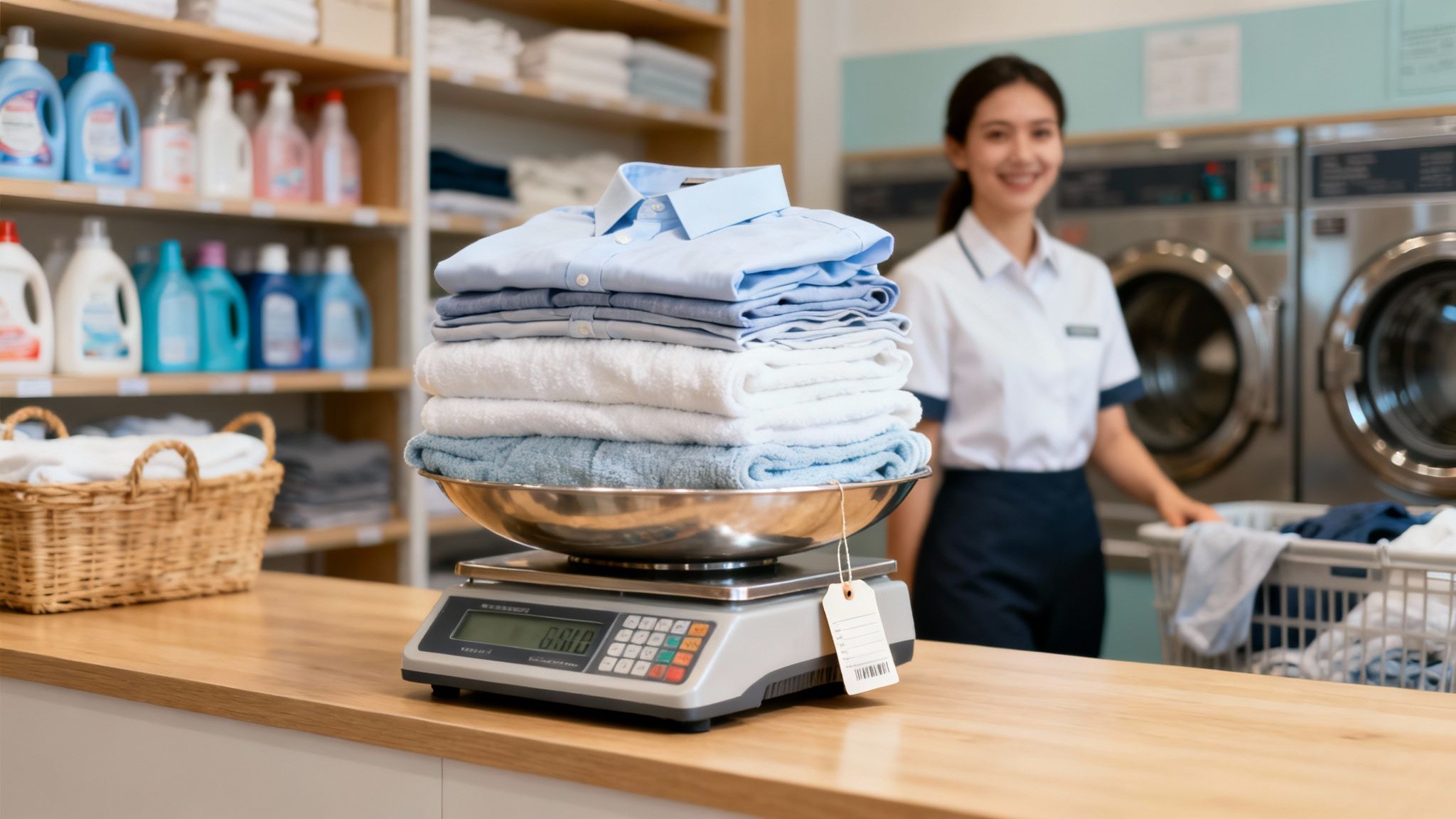
Columbia Pike Laundry offers pickup & delivery across Northern Virginia.
So, how much should you expect to pay for a wash and fold service? On average, the going rate is anywhere from $1.00 to $3.50 per pound. That's a pretty wide range, and it all comes down to where you live, what kind of service you need, and the convenience factor of pickup and delivery.
Your Quick Guide to Laundry Service Pricing

When you hand over your laundry, you're not just paying someone to wash your clothes. You're literally buying back hours of your life. That's why most services use a simple cost-per-pound model—it's a fair and transparent way to charge you for exactly what you need done. No more, no less.
But that base rate is just the starting point. Several other factors can nudge the final price up or down, and understanding them ahead of time means no surprises when the bill comes.
Location, Location, Location
Just like with real estate, geography is a huge deal in the laundry world. A laundromat in a bustling city has higher rent and labor costs, and that gets passed on to the customer.
You'll see this reflected in the prices. In major U.S. cities, it's common to find wash and fold services priced between $2.00 and $3.50 per pound, especially if you add pickup and delivery. Head out to the suburbs or a smaller town, and you'll likely find much friendlier prices, often in the $1.00 to $1.75 range. It all comes down to local operating costs and demand.
Key Takeaway: Your zip code is one of the biggest predictors of your laundry service cost. Expect to pay a premium for services in major metropolitan areas compared to smaller towns.
Understanding the Baseline Costs
To give you a clearer picture, it helps to see the numbers side-by-side. Here's a quick look at what you can generally expect to pay based on where you are and the type of service you choose.
Typical Wash and Fold Service Costs at a Glance
This table provides a quick summary of typical wash and fold laundry service costs across different settings and service levels.
Service SettingTypical Cost Range (Per Pound)Key Influencing FactorsSuburban/Rural Drop-Off$1.00 – $1.75Lower overhead costs, less demand, basic service options.Urban Center Drop-Off$1.75 – $2.50Higher rent and labor costs, more competition, standard service.Pickup & Delivery Service$2.00 – $3.50+Added convenience, fuel and driver costs, often includes premium features.
Think of these ranges as your starting point. As we'll cover next, things like special detergents, bulky items, and rush orders can all add to the final tally.
Deconstructing the Price Per Pound Model

When you first look into a wash and fold service, the whole "price-per-pound" thing can feel a little odd. Why not just charge by the bag or by the item? It really comes down to one thing: fairness. Charging by weight is the industry's way of making sure you only pay for exactly what you need washed.
Think about it like buying produce at the grocery store. You wouldn't expect to pay the same price for a few apples as someone buying a whole bushel. The per-pound system for laundry works on that same simple, scalable logic. It creates an honest exchange for both you and the laundry service.
This model means a college student with a small bag of clothes and a large family with overflowing hampers can both get a fair price based on their actual needs. It cuts out the guesswork and standardizes the cost in a way that's easy for everyone to get behind.
What Is Included in the Per Pound Rate?
That simple per-pound rate you see is actually an all-inclusive price. It covers the entire journey your clothes take from the hamper back to your drawer, perfectly clean and folded. Every pound you pay for funds a careful, multi-step process handled by pros.
First off, there's the labor. This is the biggest piece of the puzzle, covering the time and skill it takes to sort your clothes by color and fabric, choose the right wash cycles, and get everything into the machines. After the washing and drying, every single item is expertly folded and neatly packaged for its trip home.
Then you have all the behind-the-scenes operational costs. These include:
- Utilities: Powering commercial-grade washers and dryers takes a significant amount of water, electricity, and gas.
- Professional-Grade Supplies: This covers high-quality detergents, softeners, and stain removers that are far more powerful than what you'd typically find at the store.
- Equipment Maintenance: Those big, commercial machines are a serious investment. They need constant upkeep and occasional repairs to run efficiently and keep your clothes safe.
Basically, the price per pound bundles all these essential costs into one simple, transparent number. If you're curious and want to dive even deeper, our complete guide to per-pound laundry pricing breaks it down even more.
The Operational Logic Behind Weight-Based Pricing
From the laundry service's perspective, the per-pound model is the only way that makes sense for managing workflow and resources. Weight is the most direct way to measure the labor, machine space, water, and detergent an order will need. A 15-pound load requires a predictable amount of resources, while a 40-pound load requires a whole lot more.
This direct link makes pricing sustainable for the business. It allows them to accurately estimate their costs and set a fair rate that keeps the lights on while still giving you great value. The alternative would be messy item-by-item pricing or vague bag-size estimates, which almost always lead to confusion and unfair charges.
By tying the wash and fold service cost directly to the weight of the laundry, providers create a system that is both transparent for the customer and operationally sound for the business. It's a win-win that has become the industry standard for a reason.
This system also eliminates any confusion. One person's "small bag" can be another person's "medium." But 15 pounds is 15 pounds—it's a concrete measurement nobody can argue with. This clarity builds trust and guarantees that every customer is treated fairly, paying only for the service they truly use.
What Really Goes Into Your Final Bill?
The per-pound rate you see advertised is just the starting line. Think of it like the base price for a new car—it gets you in the door, but the features you actually want and need are what determine the final cost. When it comes to wash and fold, several things can shift that initial number, from the soap you prefer to how fast you need your clothes back.
Getting a handle on these variables is the key to making a laundry service work for your budget. It lets you decide what's truly important, so you're only paying for the extras you value, with no sticker shock at the end.
Premium Products and Special Treatments
Let's be honest, not all laundry loads are the same. Sometimes your clothes need a little extra TLC. A standard wash and fold service will use a solid, professional-grade detergent that gets the job done well. But many places, including us, offer upgrades for more specific needs.
For instance, if you or a family member has sensitive skin, you might want to switch to a hypoallergenic or fragrance-free detergent. This usually adds a small fee, either a few cents per pound or a flat rate for the whole order. The same goes for stubborn stains. If you've got a tough grass or wine stain, a specialized spot treatment can make all the difference, and that's typically an add-on service.
The Bulky Item Conundrum
Ever wonder why your big, fluffy comforter has its own price tag? It all comes down to simple machine math. One king-sized comforter can easily fill an entire commercial washer and dryer all by itself. That's the same amount of space that could hold 15-20 pounds of regular clothes like t-shirts and socks.
Because these large items monopolize a machine for a full wash and dry cycle (and they take forever to dry properly), they're priced individually. This keeps things fair for everyone. A flat rate—say, $25 for a comforter—is a much more accurate reflection of the time, energy, and machine capacity it uses than trying to shoehorn it into a price-by-the-pound model.
The Price of Speed and Convenience
In our busy lives, time is often the one thing we can't get more of. Laundry services get that, which is why they offer options that trade a little extra cost for a lot of time saved.
Below is a quick look at some common services that might add to your base wash and fold cost, along with what you can generally expect to pay for them.
Common Surcharges and Add-On Costs
Additional ServiceTypical Pricing MethodExample Cost RangeSpecialty DetergentsPer-pound surcharge or flat fee+$0.10 per pound or +$2-$5 per orderRush/Express ServicePercentage surcharge or flat fee+25-50% of the total or a +$15-$25 feePickup & DeliveryFlat fee or integrated into a higher per-pound rate$5-$15 delivery fee per orderStain TreatmentPer-item fee$3-$10 per garment, depending on severity
These are just a few examples, but they illustrate how you can customize your laundry service to fit your exact needs.
Of course, the biggest game-changers are usually speed and delivery.
- Express or Rush Service: If you need your laundry back ASAP—like, same-day or within 24 hours—most places have an express option for a premium. That fee essentially lets you jump the line, and it compensates the team for reorganizing their workflow to prioritize your order.
- Pickup and Delivery: This is the ultimate convenience hack. Someone comes to your door, whisks away your dirty laundry, and brings it back clean and neatly folded. This service almost always has a separate delivery fee, or it's baked into a slightly higher per-pound rate. For a deeper dive, check out our complete guide to laundry pickup and delivery.
The cost of convenience is a real and measurable factor. Adding services like pickup and delivery can significantly increase the total, but for many, the time saved is well worth the investment.
Understanding Minimum Orders
You've probably seen that most laundry service's have a minimum charge, like $38 for drop-off or $50 for delivery. This isn't just an arbitrary number—it's essential for making the business model work. Think about it: the cost of running a load of laundry (labor, utilities, soap) is pretty much the same whether it's 5 pounds or 25 pounds. The same goes for delivery, which adds fuel and a driver's time to the equation.
A minimum charge ensures that every transaction covers these basic operational costs, which allows the service to keep its per-pound pricing fair and competitive for everyone. It's a standard practice you'll find in many service businesses. While laundry is our world, it can be helpful to see how other personal services are structured. For example, you can see similar models when exploring what a personal chef service might cost.
The numbers back this up, especially for services with a transport component. The average pickup and delivery order comes in around $79.81, which is nearly 80% more than the average $44.19 for a drop-off order. That difference highlights the real costs tied to logistics.
Let's Do the Math: Figuring Out Your Own Laundry Service Cost

Price ranges are great, but what does that actually mean for your laundry basket? Let's move past the abstract and get practical. Seeing how the numbers add up in a few real-world scenarios is the best way to understand how wash and fold service cost really works.
Walking through these examples helps you see exactly how the final bill gets put together, piece by piece. You'll get a feel for estimating your own laundry weight, see how common add-ons affect the price, and learn to anticipate the total before you even book a pickup.
Scenario 1: The Busy Single Professional
First up is Alex, a consultant with a demanding schedule. Convenience is everything. Alex sends out laundry every couple of weeks, a mix of work attire, gym clothes, and weekend wear.
How much does it all weigh? A simple trick is to use a standard kitchen trash bag as a guide—when stuffed, it holds around 15 pounds of clothing. That's about what Alex has.
- Estimated Laundry Weight: 15 lbs
- Sample Per-Pound Rate: $2.25/lb
- Pickup & Delivery Fee: $5.00
Here's the breakdown:
- Base Laundry Cost: 15 lbs x $2.25/lb = $33.75
- Add Delivery Fee: $33.75 + $5.00 = $38.75
- Final Estimated Cost: $38.75
But wait. This total falls short of the common $50 minimum for delivery services. In this case, Alex's final bill would be bumped up to meet that minimum. It's a key detail to keep in mind, especially for smaller orders.
Scenario 2: The Family of Four
Now, let's look at the Harris family. With two adults and two kids, the laundry piles up—fast. Their weekly load is a mountain of adult clothes, kid's outfits, towels, and, this week, a queen-sized comforter.
Their volume is much larger, easily filling two big laundry bags. We'll estimate this at 40 pounds. Plus, they have that one bulky item, which is always priced separately.
Why are comforters priced differently? It's simple, really. Bulky items like comforters, sleeping bags, and large blankets need an entire machine to themselves. Pricing them individually is the standard, fair way to account for the extra resources they use.
Let's run the numbers for the Harris family:
- Estimated Laundry Weight: 40 lbs
- Sample Per-Pound Rate: $2.25/lb
- Bulky Item Surcharge (Queen Comforter): $25.00
- Pickup & Delivery Fee: $5.00
The math looks like this:
- Base Laundry Cost: 40 lbs x $2.25/lb = $90.00
- Add Bulky Item: $90.00 + $25.00 = $115.00
- Add Delivery Fee: $115.00 + $5.00 = $120.00
- Final Estimated Cost: $120.00
Their total is well over the minimum, so they're only paying for what they sent in plus the standard fees. It's a perfect example of how a typical family's wash and fold service cost is calculated.
Scenario 3: The College Student Emergency
Finally, meet Maya. She's a college student buried in finals week and has officially run out of clean clothes. She has a big presentation tomorrow and needs everything back, ASAP. This is a classic case for express, or rush, service.
Her load is small—just 12 pounds—but the urgent turnaround time adds a serious premium.
- Estimated Laundry Weight: 12 lbs
- Sample Per-Pound Rate: $2.25/lb
- Express Service Surcharge: 50% of the base laundry cost
- Pickup & Delivery Fee: $5.00
Here's how Maya's emergency order adds up:
- Base Laundry Cost: 12 lbs x $2.25/lb = $27.00
- Calculate Express Fee: $27.00 x 0.50 = $13.50
- Add It All Together: $27.00 (laundry) + $13.50 (express) + $5.00 (delivery) = $45.50
- Final Estimated Cost: $45.50
Just like with Alex, Maya's total is under that typical $50 delivery minimum. Her final charge would be adjusted up to $50.00. This shows how rush fees and order minimums can work together, especially on smaller, time-sensitive loads.
Smart Ways to Lower Your Laundry Bill

Knowing how wash and fold pricing works is one thing, but using that knowledge to actually save money is where the real magic happens. Getting a handle on your wash and fold service cost doesn't mean you have to sacrifice the convenience you love. It's all about making smarter choices.
With just a few tweaks to how you handle your laundry, you can see a real drop in your monthly spending. These aren't complicated hacks—just practical, effective ways to get the best value every single time you schedule a pickup.
Embrace the Power of Subscriptions
If you find yourself using a wash and fold service pretty regularly, signing up for a subscription or a recurring pickup is almost always the best way to save. It's like getting a membership at your favorite coffee shop; your loyalty is rewarded with better pricing. Most laundry services offer a lower per-pound rate to customers who commit to a consistent schedule.
This consistency helps them plan their workload, and they're happy to pass those operational savings on to you. But the benefits usually go beyond just a better rate.
- Waived Delivery Fees: That typical $5 to $15 delivery fee really adds up. Subscriptions often get rid of it completely.
- Priority Scheduling: Regulars tend to get first pick of the most convenient pickup and delivery times.
- Exclusive Discounts: You might also get perks like special offers on dry cleaning or other services a few times a year.
Monthly subscriptions for weekly service typically run from $60 to $100 for one person and can go up to $200 to $400 for a family. This pricing reflects how the laundry industry balances its own costs with customer demand for reliable, convenient service.
Bundle Services to Meet Minimums
You've probably noticed that minimum order value, which is often around $50 for delivery. It's not just a random number; it covers the essential costs of sending a driver out, like fuel and time. For a single person or a small household, hitting that minimum with just laundry every single week can be tough. That's where bundling is your best friend.
Instead of sending a small batch of laundry and having the price bumped up to the minimum anyway, just add your dry cleaning to the same order. It's the perfect time to get that suit, a few silk blouses, or a winter coat cleaned.
By bundling wash and fold with dry cleaning, you're not spending more money overall. You're simply consolidating your errands into a single, efficient order that easily meets the minimum, ensuring every dollar you spend goes toward clean clothes.
This strategy is a double win. It saves you money and streamlines your to-do list into a single pickup and delivery. Fewer logistics for you to worry about.
Adopt Smart Laundry Habits
Sometimes the smallest changes can have the biggest impact on your bill. A few simple, mindful habits can help you steer clear of surprise fees and keep your wash and fold service cost right where you want it.
- Pre-Sort Your Clothes: While professionals will always sort your clothes, some charge a small fee if a load is a complete jumble. Taking two minutes to separate your whites, colors, and delicates can help you avoid any extra handling charges.
- Check for Off-Peak Discounts: It never hurts to ask. See if your service offers a small discount for scheduling pickups during their slow times, like a Tuesday afternoon. Laundromats value a balanced workflow and might just reward you for helping them out.
- Consolidate Your Loads: If you don't generate enough laundry each week to hit the delivery minimum without overpaying, try switching to a bi-weekly schedule. You'll send in a larger, more cost-effective load each time.
How We Price Our Services at Columbia Pike Laundry
We think the best price is a straightforward one. At Columbia Pike Laundry, we skip the hidden fees and confusing jargon. Our goal is to be completely upfront about costs so you can choose exactly what you need without any surprises. After all, getting your laundry done should make your life easier, not more complicated.
Our standard wash and fold service is priced to give you fantastic value. That price covers everything from careful sorting and washing with top-notch detergents to professional drying and folding. When you get your clothes back, they're fresh, neat, and ready to go right back in the drawer.
The Key Details
To give you a clear picture, here's how our pricing works. For the full, nitty-gritty breakdown, you can always check out our complete wash and fold pricing information.
- Minimum Orders: For drop-off service, we have a $38 minimum. If you're using our super-convenient pickup and delivery, the minimum is $50. This helps us cover the costs of giving every single order our full attention.
- Bulky Items: Big stuff like comforters needs its own space and a little extra care. A standard machine-washed comforter costs $25 per item. If it needs to be dry-cleaned, the price is between $30 and $35.
- Detergent Choices: Our house standard is a high-quality, gentle Free & Clear detergent. If you have a favorite, you can upgrade to Tide or Gain for a small extra charge.
Your peace of mind is our top priority. We guarantee your clothes are always washed and dried in dedicated machines—never mixed with anyone else's. It's a core part of our commitment to you.
Getting Your Laundry Back: Standard vs. Express
Life moves fast, and we're here to keep up. We offer two turnaround times to fit your schedule.
Our standard service will have your fresh, folded laundry back to you within 48 hours.
In a real pinch? Choose our Express service. We'll have your laundry ready in 24 hours or less, perfect for those last-minute laundry emergencies.
Common Questions About Wash and Fold Costs
Even after breaking down the numbers, you might still have a few questions floating around. Let's tackle some of the most common ones we hear, so you can feel completely confident about using a professional laundry service.
Is a Laundry Service Really Cheaper Than Doing It Myself?
It's easy to look at the per-load cost at home or a coin-op and think it's the cheaper route. A typical self-service wash might run you $5.00 to $8.00, and drying can add another $4.00 to $6.00. But that simple math leaves out the most important factor: your time.
Honestly, when you add up all the hours spent sorting, washing, drying, folding, and driving back and forth, the real cost becomes clear. A professional wash and fold service Dry Cleaning isn't just about getting clean clothes; it's about buying back your weekend.
Think of it this way: If you value your free time at even a modest rate, outsourcing your laundry often comes out as the more economical—and far less stressful—choice.
How Do I Know the Weight Is Accurate?
That's a perfectly fair question, and the answer comes down to transparency. Any reputable laundry service uses certified, commercial-grade scales that are regularly calibrated to ensure they're spot-on. As soon as your laundry arrives, we weigh it, and that weight is what your final charge is based on.
We believe in building trust. That's why your final receipt will always show the exact weight of your order. It's a simple, straightforward process designed to be fair for everyone.
Should I Separate My Clothes Before Pickup?
You certainly don't have to—that's part of what you're paying for! Our team is professionally trained to sort everything into whites, colors, and delicates to make sure every item gets the right treatment.
That said, if you have specific pieces that need special care—like a delicate blouse you want air-dried—the best way to guarantee your instructions are followed is to put them in a separate, clearly labeled bag.
What Happens If an Item Gets Damaged?
We handle every garment with professional care, so damage is incredibly rare. But we're also realistic and know that accidents can happen. In the unlikely event an item is damaged, please get in touch with us right away. We stand by our service and will work with you to find a fair and satisfactory solution.
Ready to reclaim your time and get perfectly clean laundry without lifting a finger? Columbia Pike Laundry makes it easy.
Free pickup, expert care, delivered back to your door.
Popular Blog Articles






Meet the Author
Daniel Logan didn’t start CPL because he loved laundry. He started it because his family was drowning in time debt, and laundry was one of the biggest weights.
Mornings were chaos with two kids under 5. Evenings felt like catch-up. And weekends? Gone to sorting socks and folding piles.
He knew his story wasn’t unique. So he built a business that gave families like his just a little bit of breathing room one load at a time.
With no laundry experience but deep tech skills, Daniel rolled up his sleeves, doing every job himself while building systems that turned it into a modern laundry service that saves customers time, simplifies their lives, and delivers reliability they can count on.
That’s where CPL began. Not from a playbook, but from pain. From one dad trying to buy back time: for himself, and for every household like his.
Free pickup, expert care, delivered back to your door.