
Commercial Laundry Cost for Business Owners: 2026 Guide

Columbia Pike Laundry offers pickup & delivery across Northern Virginia.
The cost of commercial laundry services typically runs between $0.65 and $1.50 per pound, with most businesses landing in the $0.75 to $1.10 range when pickup and delivery are included. Monthly totals vary widely: a small gym or salon might spend $800 per month, while a mid-size hotel can easily exceed $5,000. The industry term for this category is contract laundry services, and understanding how pricing is structured gives you real leverage when evaluating vendors, negotiating terms, and building an accurate budget.
What determines the cost of commercial laundry services?
Commercial laundry pricing is not a flat rate. It is a layered structure built on volume, speed, service type, and contract terms. Knowing each layer helps you predict your actual monthly spend rather than being surprised by your first invoice.
Volume and tiered pricing
Volume is the single most powerful lever in commercial laundry pricing. Processing 1,000+ lbs per week can reduce your per-pound rate by 20% to 35% compared to smaller loads. Most providers set pricing tiers at 500 and 1,000 pounds per week, so crossing those thresholds meaningfully changes your unit cost. If you are close to a tier threshold, consolidating pickups or timing volume spikes strategically can push you into a lower rate bracket.
Turnaround time and rush fees
Speed costs money in commercial laundry. Standard 24 to 48-hour turnaround is the baseline rate. Same-day service adds 15% to 25%, and rush or emergency processing adds 30% to 50% on top of base pricing. That premium compounds fast if your operation regularly needs last-minute turnarounds. Scheduling discipline, not just vendor selection, directly controls this cost.
Specialized processing and add-on fees
Not all laundry is priced the same. Healthcare laundry requires OSHA-compliant protocols that add 15% to 30% to base prices. Industrial workwear with heavy soiling, delicate fabrics requiring special handling, and items needing pressing or packaging all carry surcharges. Minimum order requirements are also common. If your weekly volume falls below the provider’s minimum, you pay for that minimum regardless.

Contract terms and their effect on pricing
Longer commitments of 6 to 12 months lower rates by 10% to 15% compared to month-to-month arrangements. That discount is real money over a year. Month-to-month flexibility has value if your volume is unpredictable, but once you have three months of data on your actual usage, locking in an annual contract almost always pays off. You can explore key pricing factors in more detail to understand how each variable interacts.
Pro Tip: Ask vendors to itemize every fee before signing: per-pound rate, delivery charge, minimum order fee, and any fuel surcharges. A lower headline rate with high delivery fees often costs more than a slightly higher per-pound rate with free pickup.
How does outsourcing commercial laundry compare to owning machines?
This is the question most business owners ask once their laundry volume grows. The answer depends on your scale, facility constraints, and appetite for operational complexity.
Equipment purchase and installation costs
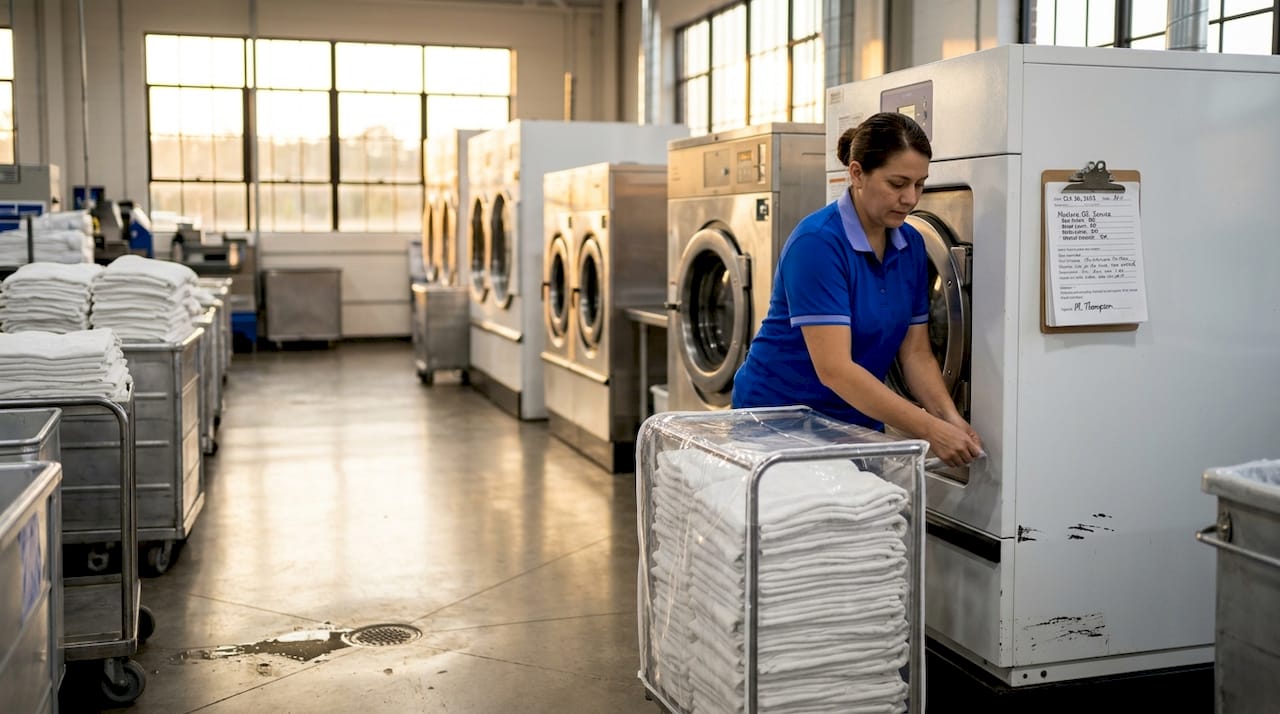
A 20-lb commercial washer costs $1,500 to $3,000. A 50-lb washer runs $3,000 to $5,000, with dryers priced similarly. Installation and setup add $1,000 to $5,000 per machine, and that figure climbs if your facility needs electrical upgrades, plumbing work, or ventilation modifications. A two-machine setup for a mid-size operation can require $15,000 to $20,000 before you wash a single load.
Operating costs when you run laundry in-house
Equipment purchase is only the beginning. Operational costs for a laundry service average about $25,200 per month, dominated by payroll at $14,375 and fixed overhead near $9,150, with utilities accounting for roughly 45% of revenue. That data reflects a standalone laundry operation, but the cost structure applies to any in-house setup. Labor, water, electricity, detergent, and machine maintenance add up faster than most operators project.
Leasing versus buying equipment
Leasing commercial laundry equipment reduces upfront costs and typically includes maintenance, with lease payments often tax-deductible as a business expense. Leases may also bundle delivery and installation, saving roughly $1,000 per machine. For businesses that want in-house control without a large capital outlay, leasing is worth modeling against a three-year outsourcing contract.
The outsourcing cost savings case
Outsourcing laundry saves 23% to 38% on total laundry costs by eliminating labor, utilities, equipment maintenance, and dedicated floor space. For a business spending $3,000 per month on in-house laundry operations, that is $690 to $1,140 in monthly savings. The case for outsourcing laundry is strongest for businesses where laundry is not a core function and where floor space has better uses.
Pro Tip: Before committing to equipment, calculate your true monthly in-house cost including staff time, not just machine costs. Most businesses undercount labor by 40% because laundry duties are folded into existing roles rather than tracked separately.
Cost CategoryIn-House OperationOutsourced ServiceUpfront investment$10,000–$25,000+ (equipment + installation)$0 (no capital required)Monthly labor$1,500–$5,000+ depending on volumeIncluded in per-pound rateUtilitiesHigh; ~45% of operating revenueNoneMaintenance$500–$2,000/year per machineNone (vendor responsibility)FlexibilityFixed capacity; hard to scaleScales with volume immediately
Typical monthly laundry expenses by industry
Average laundry expenses vary significantly by industry because volume, fabric type, and soiling level all differ. The numbers below reflect realistic monthly ranges based on current commercial laundry pricing data.
Hotels and hospitality generate the highest laundry volumes. Sheets, towels, robes, and restaurant linens add up fast. Monthly costs for hotels typically run $2,500 to $8,000, with larger properties exceeding that range. The per-pound rate often drops to $0.75 or below at this volume due to tiered pricing.
Restaurants and food service deal with tablecloths, napkins, chef coats, and aprons. Monthly laundry expenses for a full-service restaurant typically fall between $600 and $2,000. Grease and food staining can push items into a higher processing tier, so fabric type and soiling level matter when getting quotes.
Healthcare and medical offices face the highest per-pound rates due to OSHA compliance requirements. A small clinic might spend $1,200 to $3,500 per month. The 15% to 30% premium for compliant processing is non-negotiable in this sector.
Gyms, salons, and spas use towels and linens at high frequency but lower total weight. Monthly costs typically range from $400 to $1,500. These businesses benefit most from laundry services for small businesses that offer flexible minimums and reliable weekly pickup schedules.
Janitorial and cleaning services launder mop heads, microfiber cloths, and uniforms. Monthly costs are generally $300 to $900, but heavily soiled industrial items can carry surcharges that push totals higher.
How to budget for commercial laundry costs effectively
Budgeting for laundry service costs requires looking past the per-pound headline rate. The true all-in cost includes delivery fees, minimum order charges, rush premiums, and any specialized processing surcharges. A vendor quoting $0.80 per pound with a $75 delivery fee and a 100-lb minimum can cost more than a $0.95 per pound provider with free pickup and no minimum.
Pro Tip: Request a quarterly pricing review clause in any annual contract. This protects you if your volume drops significantly and prevents you from paying for capacity you no longer need.
Key takeaways
Outsourcing commercial laundry at the right volume and contract length consistently delivers lower total costs than in-house operations for most businesses outside the hospitality sector.
PointDetailsBase pricing rangeMost businesses pay $0.75 to $1.10 per pound with pickup and delivery included.Volume is the key leverCrossing 1,000 lbs per week can reduce your per-pound rate by up to 35%.Outsourcing saves moneyOutsourcing eliminates labor, utilities, and maintenance, saving 23% to 38% over in-house operations.Contract length mattersA 6 to 12-month commitment lowers rates by 10% to 15% versus month-to-month pricing.True cost includes all feesAlways calculate delivery charges, minimums, and surcharges before comparing vendor quotes.
What I’ve learned about budgeting for commercial laundry
The biggest mistake I see business owners make is treating commercial laundry pricing as a commodity decision. They compare per-pound rates across three vendors and pick the lowest number. That approach almost always costs more in the long run.
The real cost drivers are turnaround reliability and volume predictability. A vendor who consistently delivers on time eliminates the need for rush orders, which is where budgets quietly collapse. One emergency same-day order per week at a 40% premium can wipe out the savings from a lower base rate entirely.
I also think the buy-versus-outsource debate is often framed too narrowly around equipment costs. The harder question is whether your team has the bandwidth to manage an in-house operation without it degrading the quality of their primary work. In my experience, the labor cost of in-house laundry is always underestimated because it is distributed across existing roles rather than tracked as a dedicated expense.
For most small and mid-size businesses, the math favors outsourcing until you reach a scale where a dedicated laundry operation makes operational sense. That threshold is higher than most owners think. Get three months of actual volume data, calculate your true all-in cost including staff time, and then make the decision. The numbers usually make it obvious.
See how Columbiapikelaundry handles commercial laundry for local businesses
Columbia Pike Laundry works directly with businesses in Arlington, Virginia and the surrounding area, handling uniforms, linens, and bulk items with the same in-house process used for every order. There are no third-party handoffs, which means tighter quality control and consistent turnaround. Pickup and delivery are available on a scheduled basis, and pricing is transparent with no hidden fees. Whether you run a restaurant, a medical office, or a property management operation, Columbiapikelaundry builds service plans around your actual volume and schedule. Visit Columbia Pike Laundry to request a quote or discuss a custom plan for your business.
FAQ
What is the average cost per pound for commercial laundry?
Most businesses pay between $0.75 and $1.10 per pound for commercial laundry services, including pickup and delivery. Rates can go as low as $0.65 per pound at high volumes or as high as $1.50 per pound for specialized or low-volume processing.
How much does a business spend on laundry per month?
Monthly laundry expenses range from $400 for small operations like salons to $8,000 or more for hotels, depending on volume and industry. Most mid-size businesses fall between $800 and $3,000 per month.
Does outsourcing laundry actually save money compared to buying machines?
Outsourcing saves 23% to 38% on total laundry costs for most businesses by eliminating equipment, labor, utilities, and maintenance expenses. In-house operations require $10,000 to $25,000 in upfront equipment and installation costs before ongoing operating expenses begin.
What adds cost to a commercial laundry contract?
Rush turnaround fees, healthcare compliance surcharges, delivery charges, and minimum order requirements all add to the base per-pound rate. Healthcare laundry alone adds 15% to 30% above standard pricing due to OSHA-compliant processing requirements.
How can I lower my commercial laundry service costs?
Consolidate volume to cross pricing tier thresholds, commit to a 6 to 12-month contract after a trial period, and schedule pickups to avoid rush fees. Tracking all fees as separate line items also reveals where costs can be renegotiated.
Free pickup, expert care, delivered back to your door.
Popular Blog Articles




Meet the Author
Daniel Logan didn’t start CPL because he loved laundry. He started it because his family was drowning in time debt, and laundry was one of the biggest weights.
Mornings were chaos with two kids under 5. Evenings felt like catch-up. And weekends? Gone to sorting socks and folding piles.
He knew his story wasn’t unique. So he built a business that gave families like his just a little bit of breathing room one load at a time.
With no laundry experience but deep tech skills, Daniel rolled up his sleeves, doing every job himself while building systems that turned it into a modern laundry service that saves customers time, simplifies their lives, and delivers reliability they can count on.
That’s where CPL began. Not from a playbook, but from pain. From one dad trying to buy back time: for himself, and for every household like his.
Free pickup, expert care, delivered back to your door.