
Streamline your laundry workflow: save 4+ hours weekly

Columbia Pike Laundry offers pickup & delivery across Northern Virginia.
TL;DR:
- An organized laundry workflow reduces time and decision fatigue for busy households.
- Core steps include sorting with multi-compartment hampers and designated zones in the laundry space.
- Consistent habits and simple systems, like daily loads and involving children, ensure long-term success.
Laundry is one of the biggest time drains in any busy household. The average American spends 4.5 hours every week just managing clothes, and for Arlington families juggling school runs, work deadlines, and evening activities, that number feels even heavier. The frustrating part? Most laundry routines fail not because of a lack of effort, but because of a lack of workflow. When there is no clear system, every load becomes a decision, and decisions pile up just like the clothes. This guide walks you through a practical, repeatable laundry organization workflow built for real life in Arlington, so you can spend less time on laundry and more time on everything else.
Key Takeaways
| Point | Details |
|---|---|
| Create laundry zones | Clearly defined laundry zones and storage make workflows easier and reduce clutter. |
| Maintain daily routines | Daily or scheduled loads prevent pile-ups and keep laundry manageable for families. |
| Prevent common problems | Scheduled hamper-emptying and mesh bags eliminate most lost or damaged items. |
| Track and optimize | Monitoring laundry benchmarks and updating your system keeps everything running smoothly. |
| Consider outsourcing | Local laundry services can save busy families and professionals hours each week. |
Set up your laundry workflow foundation
Before you can run an efficient laundry routine, you need the right setup. Think of your laundry space less like a chore zone and more like a mini production line. Every step in that line should flow naturally into the next, with as little friction as possible.
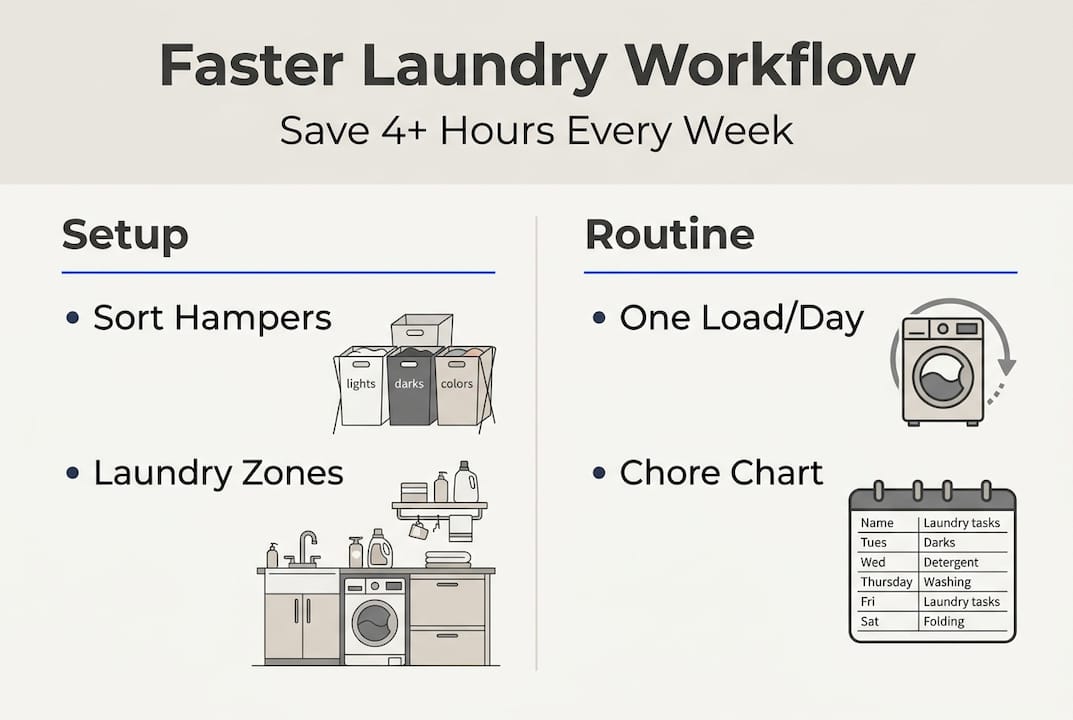
The core workflow for busy families starts with sorting by color and fabric type using multi-compartment hampers. This single habit removes one of the biggest time wasters: re-sorting at the machine. A three-section hamper labeled lights, darks, and colors means your kids (and your partner) can sort as they undress, not the night before laundry day.
Laundry room design built around workflow efficiency uses three distinct zones. Set yours up the same way:
- Entrance zone: This is where sorting happens. Place hampers near the bedroom door or bathroom.
- Central zone: Your washer and dryer live here, along with detergent, mesh bags, and stain removers within arm’s reach.
- End zone: A folding surface, whether a countertop, table, or wall-mounted board, where clean laundry gets processed before it goes away.
Vertical storage is your best friend in smaller Arlington apartments or townhomes. Wall-mounted shelves above the machine keep supplies off the floor and visible. Labeled bins reduce the mental load of remembering where things go. For clever clothes storage ideas that work in tight spaces, stackable bins and over-door organizers make a real difference.
Here is a quick reference for the tools that matter most:
| Tool | Purpose | Best for |
|---|---|---|
| Multi-compartment hamper | Pre-sort by color/type | All family members |
| Mesh laundry bags | Protect delicates and socks | Kids’ items, lingerie |
| Rolling laundry cart | Move loads between zones | Larger households |
| Chore chart | Assign tasks by person | Families with kids |
| Labeled storage bins | Reduce decision fatigue | Shared laundry spaces |
For more organizational laundry tips that work for real Arlington households, the foundation always starts with structure before speed.
Pro Tip: Use color-coded hampers for each family member. Even young children can learn to drop clothes in the right bin, which cuts your sorting time to nearly zero.
If you want to organize laundry for busy households without overhauling your entire home, start with just the hamper system. That one change alone saves most families 20 to 30 minutes per week.
Step-by-step laundry workflow in action
Now that the foundation is in place, here is how the workflow actually runs from start to finish. The goal is to make each step automatic, not effortful.
- Gather: Each morning or evening, check hampers. If one section is full, that is your load for the day.
- Sort: Because you are using a multi-compartment hamper, this step is already done. Pull the full section directly into the machine.
- Wash: Start the machine before you leave for work or school drop-off. Use a timer delay if your machine has one.
- Dry: Move the load immediately when the wash cycle ends. Leaving wet clothes sitting creates mildew and extra work.
- Fold: Fold directly from the dryer while clothes are still warm. This prevents wrinkles and skips the ironing step for most items.
- Put away: Return folded clothes to their designated spots immediately. Do not leave a folded pile on the couch.
A family of four generates 4 to 5 loads per week. Running one load daily keeps the system moving and prevents the dreaded Sunday mountain of laundry. Scheduled wash times, like whites on Monday and darks on Wednesday, remove the daily decision of what to wash.

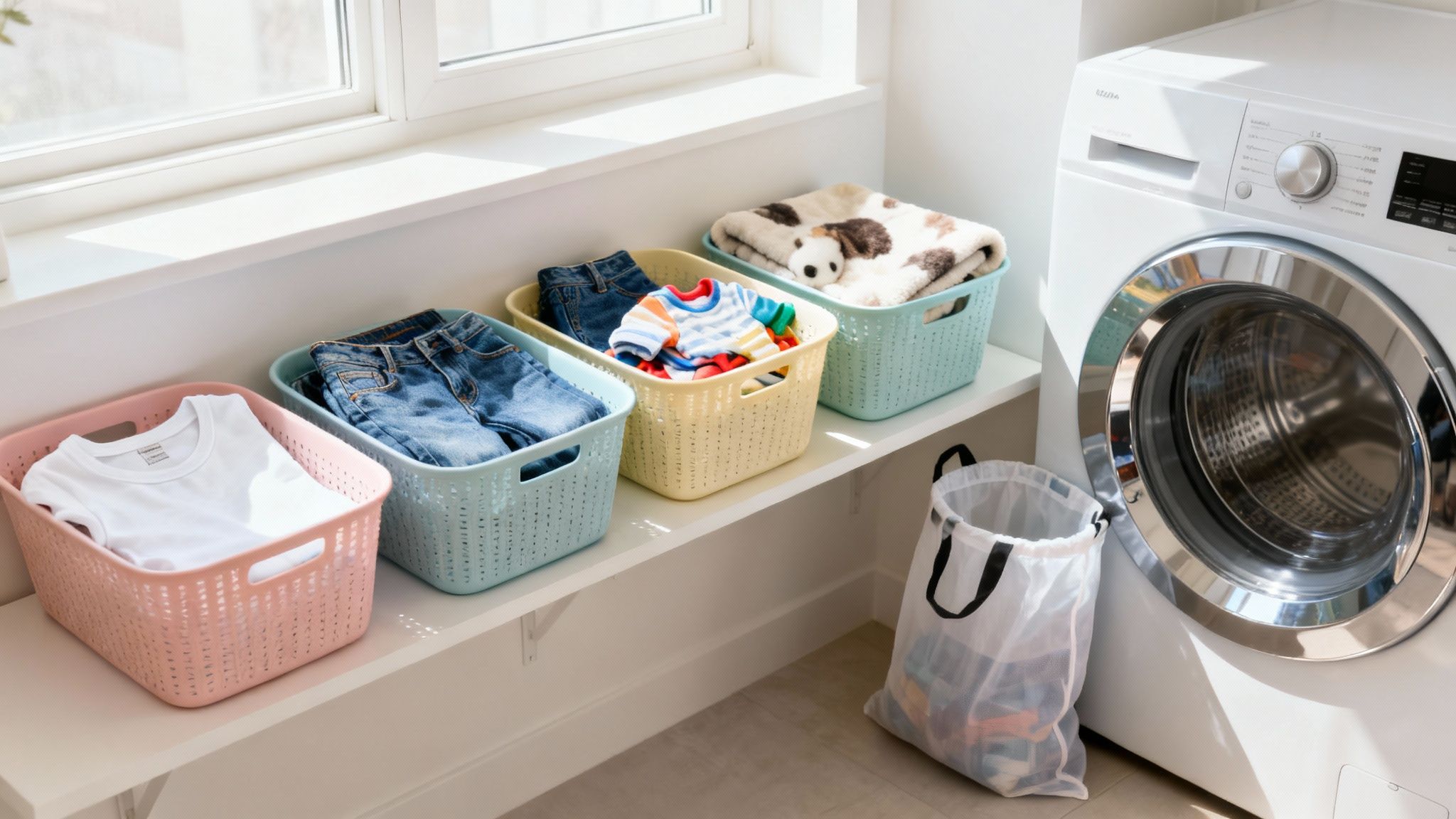
For edge cases, use mesh bags for delicates and socks and keep school uniforms in a separate bin for hot wash cycles. This protects fabrics and keeps specialty items from getting lost in the general rotation.
Delegating tasks is not optional in a busy household, it is essential. Assign age-appropriate jobs using a visible chore chart. Kids aged 5 and up can move clothes from the dryer to a basket. Older kids can fold their own items. Use small incentives like screen time or a sticker chart to build the habit.
| Factor | DIY laundry system | Professional laundry service |
|---|---|---|
| Weekly time investment | 3 to 5 hours | Under 15 minutes |
| Control over preferences | Full control | Customizable via app |
| Convenience | Requires planning | Pickup and delivery available |
| Cost | Low direct cost | Time savings offset cost |
For families looking to streamline laundry sorting even further, a professional laundry organization guide can help you decide which tasks to keep and which to hand off.
Pro Tip: Apply the one-touch rule. Handle each piece of laundry only once per stage. Pick it up, sort it, wash it, fold it, put it away. Never move it to a temporary pile.
Common laundry workflow mistakes (and how to fix them)
Even the best-designed system breaks down without consistent habits. Here are the most common failure points and exactly how to fix them.
Hamper overflow: When hampers overflow, sorting stops and chaos begins. The fix is simple: empty hampers one to two times per week on a set schedule. Treat it like taking out the trash. It is not optional.
Lost delicates and socks: These disappear because they get mixed into general loads. Mesh bags solve this completely. Hang a small mesh bag on each hamper section so family members can drop in delicates as they undress.
Unsorted loads: When someone dumps everything into one hamper section, you lose the time you saved on pre-sorting. A visible chore chart near the hamper reminds everyone of the system. For home organization best practices that stick, visual cues beat verbal reminders every time.
Here are the most common bottlenecks and their fixes at a glance:
- Overflow: Schedule hamper-emptying twice a week, not when it is full
- Lost socks: Mesh bags hung on each hamper section
- Unsorted loads: Posted chore chart with clear color labels
- Path congestion: Keep the folding zone clear between loads
- Delayed folding: Fold immediately from the dryer, never from a cold pile
- Shared space conflicts: Assign specific days per person or load type
“The one-touch rule is the single most powerful habit in laundry organization. Every time you pick something up and put it down without completing the step, you are doubling your workload.”
For laundry sorting types that fit different household sizes, the approach shifts slightly, but the core mistake is always the same: delay. The longer a load sits at any stage, the more work it creates. Learning to optimize laundry routines is really about removing the gaps between steps.
Measuring and maintaining your optimal workflow
A system without checkpoints drifts. Build in a brief weekly review and your workflow will keep improving instead of slowly falling apart.
Start with a benchmark. How many loads does your household actually need?
| Household size | Average loads per week | Recommended schedule |
|---|---|---|
| 1 to 2 people | 2 to 3 loads | Every 3 to 4 days |
| 3 to 4 people | 4 to 5 loads | Daily or every other day |
| 5 or more people | 6 to 8 loads | Daily, multiple loads |
For a family of four, 4 to 5 loads per week is the norm, and optimizing how you wash, including lower temperatures and fuller loads, can cut environmental impact by 60 to 80 percent. That is a win for your utility bill and for the planet.
Here is a numbered list of habits that keep the system running well over time:
- Weekly rotation check: Every Sunday, confirm which load types are scheduled for the coming week.
- Calendar blocking: Add laundry slots to your family calendar the same way you add appointments.
- Family feedback: Ask once a month if anything is not working. Kids notice bottlenecks too.
- Seasonal adjustment: Increase load frequency during back-to-school season or sports season.
- Supply check: Refill detergent, mesh bags, and dryer sheets before they run out, not after.
For laundry time-saving tips that go beyond the basics, tracking your actual weekly load count for two weeks reveals patterns you would never notice otherwise. Use a laundry service checklist to decide which tasks belong in your DIY routine and which are worth outsourcing. For sustainable laundry practices that reduce waste, cold water washing and air drying when possible are the easiest starting points.
Why real-world laundry success demands consistent, simple systems
Here is something most laundry guides will not tell you: the elaborate system you set up on a Saturday afternoon will not survive contact with a real Tuesday. Big overhauls feel productive, but they rarely stick in households with kids, jobs, and unpredictable schedules.
What actually works in Arlington homes is boring by design. One load a day. Hampers that sort themselves. Folding that happens at the dryer, not on the couch three days later. The families who spend the least time on laundry are not the ones with the fanciest laundry rooms. They are the ones with the most boring, consistent habits.
Child involvement is worth calling out specifically. Assigning laundry tasks to kids is not just about reducing your workload. It builds real responsibility and routine. A seven-year-old who moves clothes from the dryer to a basket is learning that household systems require everyone’s participation. That lesson scales well beyond laundry.
For laundry solutions for Arlington families and professionals, the honest truth is that the best workflow is the one you will actually repeat next week, not the one that looks best on paper.
Seamlessly outsource: When full-service laundry works for you
Even the most organized system has weeks where it simply does not happen. Travel, illness, a work sprint, a school project that ate the whole weekend. For Arlington professionals and families, those weeks are not failures. They are just life.
That is exactly where Columbia Pike Laundry comes in. Based at 2602 Columbia Pike, we handle wash and fold, dry cleaning, and even delicate fabrics, all in-house with 48-hour standard turnaround. You can schedule a pickup through our app, set your preferences once, and have everything returned folded and ready. Learn how our service works and see how little effort it actually takes to hand off the whole task. We also serve neighboring communities, including laundry service McLean and laundry service Reston, so your whole network can reclaim their time too.
Frequently asked questions
How many loads per week should a typical Arlington family do?
A family of four typically runs 4 to 5 loads per week. Spacing these out as one load per day prevents pile-ups and keeps the workflow manageable.
What is the best way to prevent lost socks and delicates?
Mesh bags for delicates and socks keep small items contained through the entire wash and dry cycle, eliminating the single-sock problem for good.
How can I get my kids involved in laundry organization?
Use a posted chore chart with color-coded hampers to give kids clear, visual instructions. Age-appropriate tasks build real responsibility and make the routine predictable for everyone.
Is there a more eco-friendly way to do laundry?
Yes. Washing at lower temperatures with full loads and minimal detergent reduces environmental impact by 60 to 80 percent, which also lowers your energy bill over time.
Recommended
Free pickup, expert care, delivered back to your door.
Popular Blog Articles



Meet the Author
Daniel Logan didn’t start CPL because he loved laundry. He started it because his family was drowning in time debt, and laundry was one of the biggest weights.
Mornings were chaos with two kids under 5. Evenings felt like catch-up. And weekends? Gone to sorting socks and folding piles.
He knew his story wasn’t unique. So he built a business that gave families like his just a little bit of breathing room one load at a time.
With no laundry experience but deep tech skills, Daniel rolled up his sleeves, doing every job himself while building systems that turned it into a modern laundry service that saves customers time, simplifies their lives, and delivers reliability they can count on.
That’s where CPL began. Not from a playbook, but from pain. From one dad trying to buy back time: for himself, and for every household like his.
Free pickup, expert care, delivered back to your door.