
Laundry Facilities for Businesses: 2026 Buying Guide

Columbia Pike Laundry offers pickup & delivery across Northern Virginia.
TL;DR:
- Choosing the right laundry facilities is crucial for protecting your business’s reputation, compliance, and profitability.
- Utilizing in-house, outsourced, or hybrid models depends on your volume, space, and industry standards, with capacity planning and automation being key factors for success.
Most business owners treat laundry as an afterthought until uniforms go missing, linens come back stained, or an OSHA inspector shows up. The reality is that choosing the right laundry facilities for businesses is one of the more consequential operational decisions you will make. Get it right and you protect your reputation, your staff, and your bottom line. Get it wrong and you are dealing with recurring quality failures, compliance headaches, and costs that quietly spiral. This guide breaks down every major factor: service models, equipment sizing, hygiene protocols, automation, and exactly how to match your choice to your actual operations.
Key Takeaways
| Point | Details |
|---|---|
| Understand your service model options | In-house, outsourced, and hybrid models each suit different business sizes and volumes. |
| Size equipment to actual volume | Hotels need 3 to 5 kg of linen capacity per occupied room daily. Hospitals need 5 to 8 kg per bed. |
| Hygiene compliance is non-negotiable | Thermal disinfection requires water at 160°F (71°C) for 25 minutes, or chemical alternatives at 125 to 150 ppm chlorine. |
| Automation pays for itself over time | AI-assisted wash cycles and chemical dosing reduce labor costs and ensure consistent sanitation quality. |
| Plan for growth from day one | Build in 30% capacity buffer when sizing industrial facilities to avoid costly upgrades later. |
Types of laundry facilities for businesses
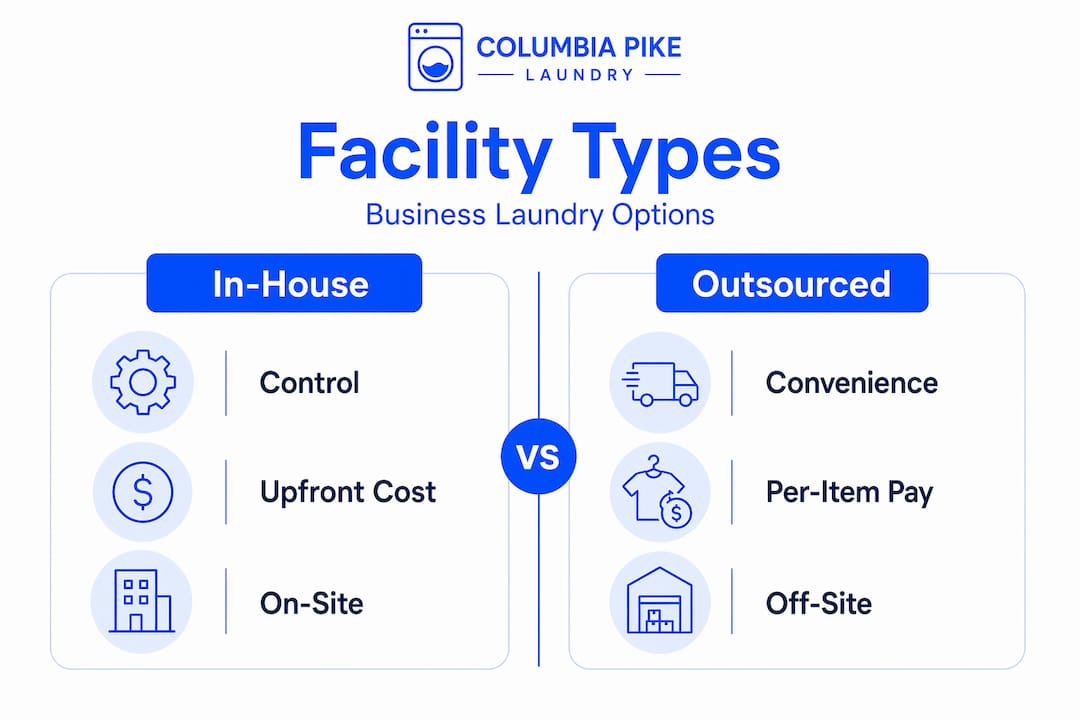
Not all laundry facilities are built the same, and that distinction matters more than most business owners realize. There are three broad service models to understand before you make any decisions.
In-house laundry facilities mean you own and operate the equipment on your premises. This gives you full control over turnaround time, quality, and compliance. Hotels, hospitals, and large property management companies often go this route because volume justifies the capital outlay. Mid-size industrial plants require capital investment from $200,000 to $500,000, while large-scale facilities can run $500,000 to over $2 million.
Commercial contract services involve sending your laundry out to a third-party facility. You pay per pound or per item, and a provider handles everything from washing to folding. This works well for smaller businesses, startups, or operations that lack the physical space for equipment. The tradeoff is less direct oversight of quality and turnaround.
Hybrid models blend both approaches. You might own machines for day-to-day items and contract out specialty or overflow laundering. Hybrid laundry solutions are increasingly popular because they offer flexibility without requiring full capital commitment. Mixing rental programs with customer-owned services is now common, with many providers offering tailored combinations rather than all-or-nothing arrangements.
Here is a quick look at which model fits which type of business:
- Hotels and resorts: High daily linen volume almost always justifies in-house or hybrid industrial laundry facilities
- Restaurants and food service: Moderate volume of aprons, towels, and table linens often suits a contract service or hybrid approach
- Healthcare facilities: Strict hygiene standards favor in-house operations with controlled protocols
- Small offices and retail: Low volume makes full outsourcing the most cost-effective choice
- Property management companies: Shared laundry rooms for tenants are a distinct model, typically using coin-operated or card-operated commercial washers
Pro Tip: Before assuming in-house is the professional choice, calculate your weekly laundry weight. Most contract service providers become cost-competitive at volumes under 200 lbs per week, which is where smaller businesses often land.
How to choose the right laundry equipment
Equipment selection is where many business owners make expensive mistakes. The most common one is buying machines sized for current volume rather than projected volume. Planning for 30% future capacity from day one prevents bottlenecks as your business grows and avoids disruptive equipment upgrades down the road.

Matching capacity to your operation
The math here is straightforward once you have your numbers. Hotels should calculate 3 to 5 kg of linen per occupied room per day. A 100-room hotel running at 80% occupancy generates roughly 240 to 400 kg of laundry daily. Hospitals run heavier at 5 to 8 kg per bed per day. These numbers directly determine the washer capacity, dryer throughput, and number of machines you need.
Commercial machines differ from industrial ones in meaningful ways. Commercial washers handle 20 to 60 lb loads and are built for moderate daily use. Industrial machines handle 100 lb or more per cycle and run continuously across multiple shifts. Buying commercial-grade equipment for an industrial-volume operation is one of the most costly mismatches you can make.
Space and utility requirements
Layout planning is often underestimated. Commercial laundry rooms require dedicated 200-amp electrical panels, often with three-phase power, plus fire-rated walls or sprinkler systems if the room exceeds 100 square feet. These are not optional upgrades. They are code requirements that affect your permitting process and occupancy approvals.
Stackable washer-dryer units save floor space but reduce per-cycle capacity and make maintenance more complex. Side-by-side configurations give technicians better access and allow faster loading and unloading during peak periods. For high-volume operations, the throughput loss from stacking rarely justifies the space savings.
Pro Tip: When estimating your utility costs, account for water, electricity, gas (if using gas dryers), and wastewater discharge fees. These operating expenses often exceed equipment depreciation in the first three years of operation.
| Machine Type | Typical Load Capacity | Best Suited For | Approximate Equipment Cost |
|---|---|---|---|
| Small retail/setup | 8 to 20 lbs per cycle | Small offices, boutique shops | $3,000 to $8,500 |
| Commercial washer-extractor | 20 to 60 lbs per cycle | Restaurants, gyms, small hotels | $8,000 to $30,000 |
| Industrial washer | 100 to 400 lbs per cycle | Hospitals, large hotels, linen rental services | $30,000 to $150,000+ |
| Full industrial plant | Multiple machines, continuous operation | Large-scale contract laundry operations | $200,000 to $2 million+ |
Hygiene, safety, and workflow standards
This is the section most business owners skim and then regret. Hygiene compliance in commercial laundry is not just about cleanliness. It is about preventing the spread of pathogens that can harm your staff, your customers, and your legal standing.
Thermal disinfection requires wash water to reach at least 160°F (71°C) for a minimum of 25 minutes. Chemical disinfection using chlorine bleach at 125 to 150 parts per million is an accepted alternative when high-heat washing is not possible for delicate textiles. Critically, adding bleach after the machine fills with water and detergent maximizes disinfection effectiveness while reducing fabric damage compared to adding it at the start of the cycle.
Here are the non-negotiable safety practices for any commercial laundry operation:
- Bag at the point of use. Contaminated laundry must be bagged where it is generated, not sorted or rinsed elsewhere first. This is a direct OSHA requirement under the bloodborne pathogens standard.
- Separate clean and soiled workflows physically. Design your facility so that dirty laundry and clean laundry never share the same handling space, cart, or transport route.
- Provide PPE to all handling staff. Gloves, gowns, and eye protection are required for workers handling potentially contaminated textiles.
- Train staff on sorting protocols. Poor sorting remains the largest compliance risk in commercial laundry operations according to OSHA guidance.
- Document cleaning cycles and temperatures. For healthcare and food service businesses, records of wash temperatures and chemical concentrations serve as compliance evidence.
“The most overlooked safety failure in commercial laundry is not the washing process itself. It is what happens between soiling and the machine: how items are collected, carried, and sorted before washing even begins.” See the commercial laundry safety guide for a full breakdown of infection control procedures.
Automation and technology in laundry operations
Automation in commercial laundry used to mean a programmable wash cycle. Today it means much more. AI-native POS systems and chemical injection technology now standardize wash cycles, manage chemical dosing precisely, and directly combat the labor cost pressures that hit laundry-heavy operations hardest.
The key insight from operators who have implemented automation is this: automation is less about replacing workers and more about removing the variability that causes quality failures and compliance gaps. A human operator adding bleach manually might add too much or too little. An automated dosing system delivers exactly 130 ppm every cycle, every time.
Practical automation investments worth considering include:
- Chemical dosing systems: Automatically inject the correct amounts of detergent, bleach, and fabric softener at the right point in each cycle
- Remote monitoring and diagnostics: Flag mechanical issues before they cause machine downtime, often sending alerts to a management dashboard or phone
- RFID linen tracking: Tag linens or uniforms individually so you always know where each item is, how many wash cycles it has completed, and when it needs replacement
- Digital workflow management: Track orders, assign staff tasks, and log completion times without paper-based systems
- Automated payment and scheduling platforms: For businesses managing tenant laundry or shared facility access, card-operated or app-based payment removes the need for cash handling
Pro Tip: Start automation with chemical dosing before anything else. It has the fastest ROI, directly improves sanitation compliance, and requires no facility redesign.
Practical steps to select and implement laundry facilities
Once you understand the options, the path forward comes down to asking the right questions in the right order. Here is a structured process to guide your decision.
-
Calculate your actual laundry volume. Weigh your laundry output for two to three representative weeks. Separate by item type: linens, garments, specialty fabrics. This number drives every decision that follows.
-
Identify compliance requirements specific to your industry. Healthcare operations face OSHA and HLAC standards. Food service businesses answer to local health codes. Hospitality businesses may face brand standard audits. Know your requirements before you select equipment or providers.
-
Evaluate your space and utilities honestly. Measure your available floor space and check your electrical panel capacity. If you cannot accommodate three-phase power and fire-rated construction, an in-house industrial facility may not be feasible without significant renovation.
-
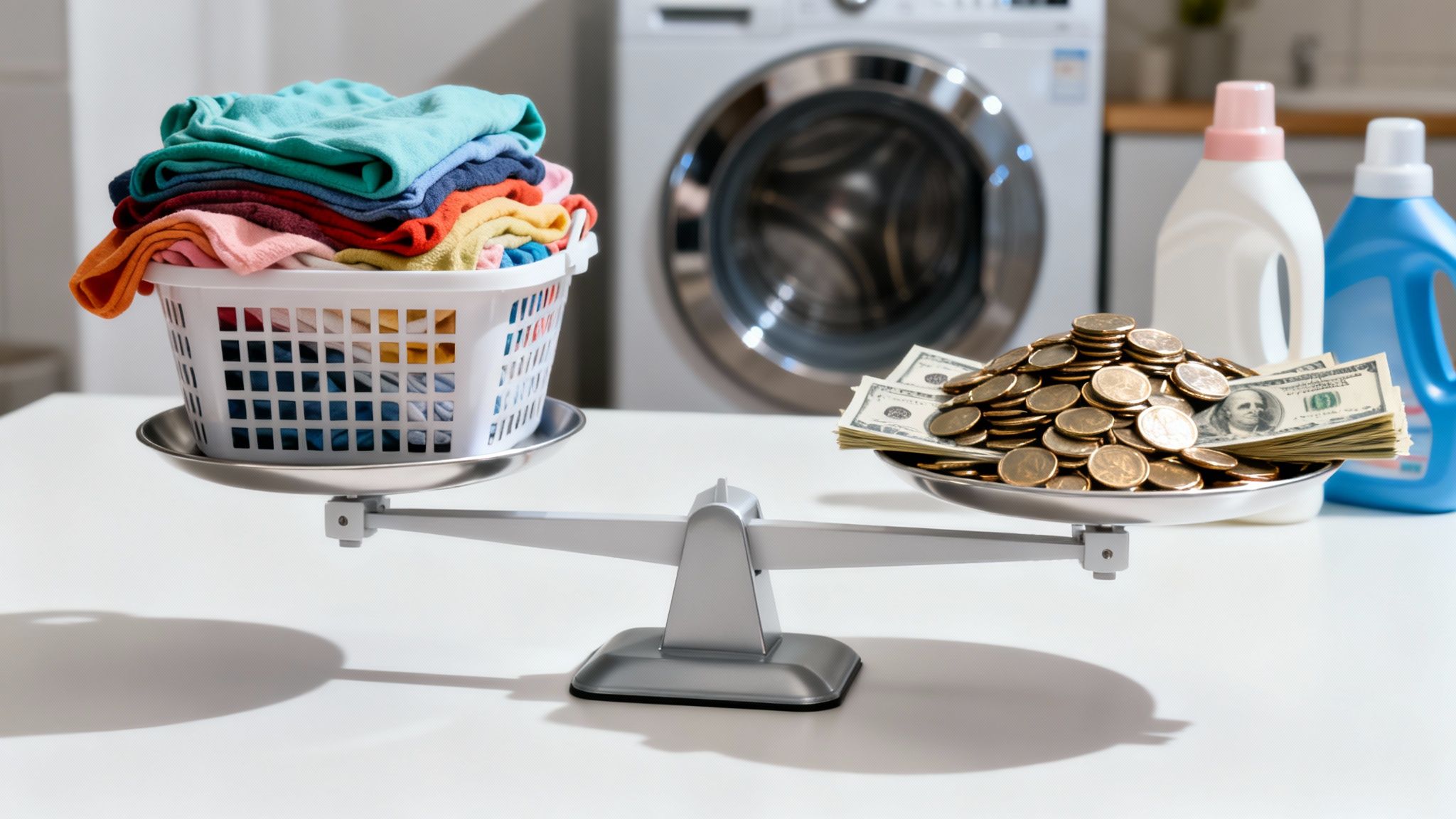
Compare total cost of ownership across models. In-house requires capital investment but lowers per-unit cost at scale. Outsourcing requires no capital but carries higher per-item costs. Use a three-year cost model that includes equipment, utilities, labor, maintenance, and service contracts.
-
Review vendor and service provider credentials. For equipment, check machine reliability ratings, parts availability, and local service technician coverage. For laundry solutions for companies, ask for turnaround time guarantees, references from similar businesses, and details on their sanitation protocols. Explore why outsourcing works for businesses that need flexibility without the overhead of ownership.
-
Plan for growth from day one. Size your facility or contract to handle at least 30% more volume than you currently need. Renegotiating a service contract is easy. Replacing undersized equipment is not.
My take on where businesses go wrong
I have seen the same pattern repeat across businesses of all sizes. The decision about laundry facilities gets made by someone focused only on the immediate problem, whether it is a broken machine or a vendor who raised prices. The result is a reactive choice rather than a strategic one, and it almost always costs more in the medium term.
What I have found is that the businesses that get this right share one habit: they treat laundry facility selection the same way they treat any infrastructure investment. They scope the problem properly, model the costs honestly, and build in room to grow. The ones that struggle are the ones who bought the cheapest machines that fit in the available space and figured they would upgrade later.
The other overlooked factor is staff training. You can buy the best laundry equipment for businesses on the market and still fail a hygiene inspection because no one trained your team on proper sorting or chemical handling. Technology and equipment do not substitute for protocol. They support it.
Hybrid service models are genuinely underutilized in my experience. Many businesses default to all-or-nothing thinking: either we own everything or we outsource everything. The reality is that a thoughtfully designed hybrid arrangement, where you handle routine volume in-house and use a professional service for specialty items or overflow periods, gives you the best of both. Laundry business logistics done well means you are rarely scrambling, regardless of demand spikes.
— Daniel
How Columbiapikelaundry supports business laundry needs
If you are running a business in the Arlington, Virginia area and need a laundry partner you can actually rely on, Columbiapikelaundry is worth a close look. As a family-owned operation at 2602 Columbia Pike, they do all cleaning in-house, which means direct quality control and real accountability on every order. There is no middleman, no subcontracted facility you have never seen.
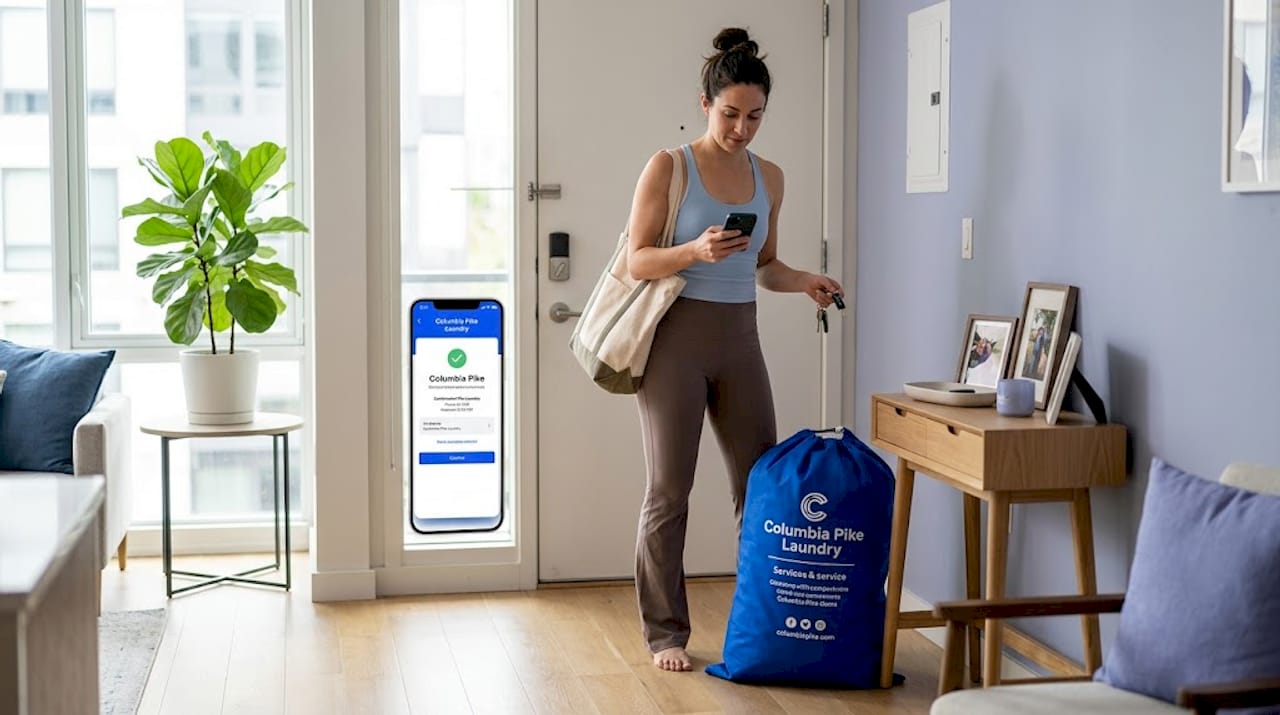
For businesses, they offer scheduled pickup and delivery, customizable preferences like fragrance-free detergents and specific folding instructions, and a 48-hour standard turnaround with express options available. You can track your order status through their app and set standing preferences so every pickup runs the same way. See how the service works and decide if it fits your operation.
FAQ
What types of laundry facilities work best for small businesses?
Small businesses with low weekly volume typically get the best value from outsourced commercial laundry services or a hybrid model. Full in-house industrial setups require capital investment starting around $3,000 to $8,500 for basic setups and much more for high-capacity operations.
How do you size laundry equipment for a hotel or hospital?
Hotels should plan for 3 to 5 kg of linen per occupied room per day. Hospitals require 5 to 8 kg per bed daily. Always build in a 30% capacity buffer to accommodate growth and peak-demand periods without bottlenecks.
What hygiene standards apply to commercial laundry operations?
Thermal disinfection requires wash water to reach 160°F (71°C) for at least 25 minutes. Chemical alternatives use chlorine bleach at 125 to 150 ppm. OSHA also requires contaminated laundry to be bagged at the point of use before transport or sorting.
Is automation worth the investment for laundry facilities for businesses?
Yes, particularly for chemical dosing systems, which deliver consistent sanitation quality and eliminate human variability. Automation is most valuable when compliance requirements are strict or when labor costs make manual processes unsustainable at scale.
What is a hybrid laundry service model?
A hybrid model combines in-house laundering for routine items with outsourced services for specialty fabrics, overflow volume, or items requiring specific treatment. It offers flexibility and cost efficiency without requiring full capital investment in owned equipment.
Free pickup, expert care, delivered back to your door.
Popular Blog Articles

Meet the Author
Daniel Logan didn’t start CPL because he loved laundry. He started it because his family was drowning in time debt, and laundry was one of the biggest weights.
Mornings were chaos with two kids under 5. Evenings felt like catch-up. And weekends? Gone to sorting socks and folding piles.
He knew his story wasn’t unique. So he built a business that gave families like his just a little bit of breathing room one load at a time.
With no laundry experience but deep tech skills, Daniel rolled up his sleeves, doing every job himself while building systems that turned it into a modern laundry service that saves customers time, simplifies their lives, and delivers reliability they can count on.
That’s where CPL began. Not from a playbook, but from pain. From one dad trying to buy back time: for himself, and for every household like his.
Free pickup, expert care, delivered back to your door.